Farm Machinery Weldments: How Volume, Seasonality and Tolerance Choices Set the Price
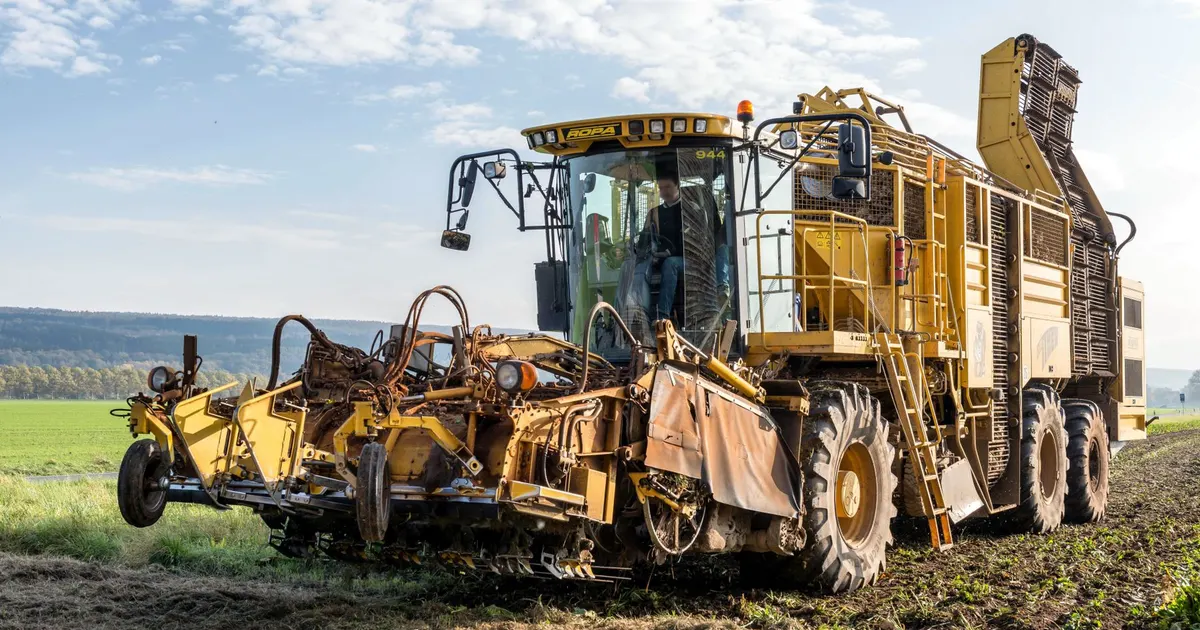
Agricultural machinery is built by the thousand and sold by the season. A tractor implement, a trailer chassis or a loader frame is welded from plate and section, painted and shipped to a dealer. The parts are rugged, the volumes are real and the margins are thin. A weldment buyer in this sector is judged on unit cost, and the unit cost depends on choices made long before welding begins.
This guide explains what the cost is made of, how volume changes it and where machining fits into a part that is mostly welded.
Typical agricultural weldments
| Part | Typical features |
|---|---|
| Implement frame (plough, cultivator, seeder) | Square tube and plate, hitch plates, tool bar |
| Trailer and wagon chassis | Long members, axle seats, hitch and draw bar |
| Loader frame and attachment | Thick plate, pivot bores, quick coupler plates |
| Sprayer boom and chassis | Light sections, pivots, folding joints |
| Grain handling equipment | Sheet metal hoppers, augers, frames |
| Tractor weights, brackets and mounts | Heavy plate, machined faces |
Most of these use plate in the 3 to 12 mm range, with heavier plate for loaders, hitches and mounts. Dimensions are modest compared with mining or press frames, which is why a great number are made in batches rather than as one-offs.
What the unit cost is made of
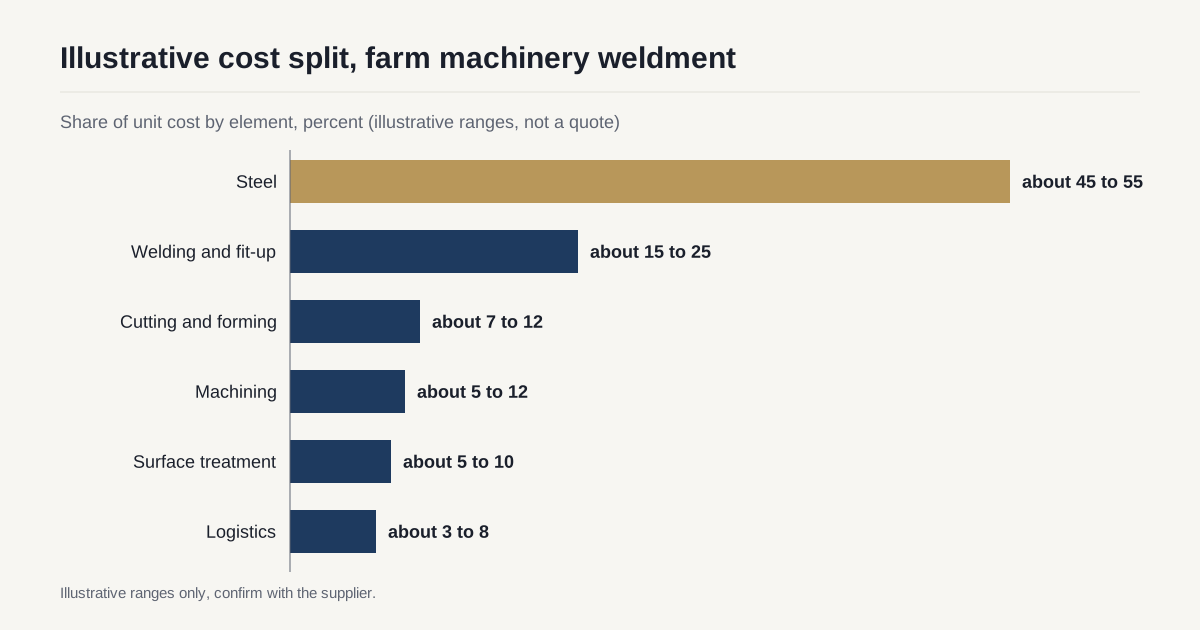
The split depends on the part, and the shares below are illustrative ranges, not a quote.
| Cost element | Illustrative share | What moves it |
|---|---|---|
| Steel (plate, tube, section) | Often the largest share, around half | Steel price, nesting yield, grade |
| Cutting and forming | Modest | Laser or plasma time, press brake time |
| Welding and fit-up | About a fifth | Weld length, jigs, robot use |
| Machining | Small to moderate | Number of bores and faces, tolerances |
| Surface treatment | Small to moderate | Blasting, e-coat or powder, paint |
| Logistics | Small to moderate | Packing, container fit, distance |
Steel often accounts for the bulk of the price. That is why saving a few percent of material, by better nesting or a thinner plate, often matters more than saving minutes of welding. A shop that nests parts well and buys plate in volume has an advantage that no clever welding can match.
How volume changes the price
Fixed costs per part number are spread across the batch, as with any repeat work.
| Fixed cost | Who pays |
|---|---|
| Weld jigs and fixtures | The shop, or charged to the buyer, depending on the contract |
| Robot programming | The shop, recovered over the batch |
| Laser and press brake programs and tooling | The shop |
| First article and inspection setup | Usually the buyer as a line item |
| Packing design | Shared |
A part made in tens per year is welded in simple fixtures by hand. At hundreds per year, a dedicated jig pays. At thousands per year, a robotic cell and a dedicated paint line are justified. The unit price falls in steps at each of those thresholds.
Robotic welding is part of that picture, and robotic welding for repeat weldment batches explains the preconditions: consistent fit-up, access and a frozen drawing.
Ask each shop to quote at several annual volumes, such as 50, 200 and 1,000. The difference between the numbers shows where each shop’s cost curve bends, and it helps you choose the volume you can commit to.
Seasonality
Farm machinery follows the farming calendar. Orders build up before the sowing or harvest season and fall away afterwards. A shop that sees a spike of orders in six weeks must find the labour, the material and the paint capacity to meet it.
Three practical steps help.
- Give a forecast. Even a soft forecast of the season’s volume lets the shop buy plate early at a better price and plan labour.
- Call off in waves. Agree a blanket order with scheduled releases rather than a single large order.
- Build stock outside the season. A shop can weld and store frames in the off-season so that the peak is mostly painting and shipping.
The effect on lead time is covered in weldment lead time.
Nesting and plate yield
Because steel is the biggest line, plate yield is worth a look. A laser or plasma cutting program places the flat shapes of many parts on one sheet, and the share of the sheet that becomes parts rather than scrap is the yield. A drawing that allows a standard plate size and a small change in the width of a bracket can lift the yield by several points. Ask the shop what plate sizes it nests on, and whether a small design change would help. A buyer who lets the shop suggest such changes often finds savings that no negotiation on the hourly rate would reach.
Where machining fits
Most of a farm machine is welded to a tolerance of a millimetre or so, because the parts are bolted together with clearance holes and the field does not care. A few features need accurate machining.
- Pivot and hitch pin bores, where wear matters
- Axle seats and bearing seats
- Mounting faces for hydraulic cylinders and gearboxes
- Quick coupler plates that must mate with standard dimensions
Everything else can be left as welded. The mistake that adds cost is to put a tight tolerance on a feature that does not need it. A bore at H7 costs more than a bore at H11, and a flatness callout on a plate that carries no precision part adds a machining setup for nothing. Machining allowance on weldments and GD&T on weldments help keep the tolerance scheme honest.
Material choices
Common choices are S235 and S355 structural steel and the equivalent ASTM grades. Higher strength steels are used to cut weight on implements. Wear parts such as ploughshares and tines use hardened or boron steels that are not welded into the structure but bolted or welded on carefully, see wear plate in weldments.
Thin plate welds with small heat input and distorts more per unit of length than thick plate. Fixtures and sequence matter. Weld distortion control explains why.
Coating
Farm machinery lives outdoors, in mud, fertiliser and weather. Corrosion protection is part of the product.
| Method | Typical use |
|---|---|
| Blasting and wet paint | Common, flexible colours |
| Powder coating | Smaller parts, durable, good coverage |
| E-coat (electrophoretic) plus topcoat | High volume, good coverage in recesses |
| Hot dip galvanising | Parts that need long corrosion life, with suitable design |
The coating choice is a cost and lead time lever. See painting and galvanising machined weldments for the comparison. Mask the pin bores and the bearing seats, or plan to ream them after coating.
What to put in the RFQ
- The annual volume, the likely order pattern and the first batch size
- The drawing revision and a note on likely changes
- The steel grade and plate thickness, with any alternatives allowed
- The features that need machining, with tolerance and datum
- The coating specification and the surfaces to mask
- Packing and shipping method, such as returnable racks or containers
- The jig and tooling arrangement: who owns it and who pays
Closing checklist
Before you send the drawing, check these points.
- You can state an annual volume and a season pattern
- The RFQ asks for prices at three volume tiers
- Tolerances are tight only where a part needs it
- The material nests well and alternatives are allowed
- Tooling ownership and payment are defined
- Coating and masking are specified, with packing suited to the shipping method
Send your weldment RFQ with the volume forecast and the tolerance scheme and each shop can show the steps in its price.
Frequently asked questions
Why are agricultural weldments sold on volume tiers?
Jigs, robot programs and tooling are fixed costs. A frame made in the hundreds or thousands spreads those costs thin and justifies better fixtures, so the unit price falls in steps as the annual volume rises. Quote at several volumes to see where the steps are.
Do farm machinery parts need tight machining tolerances?
Mostly not. Pin bores, axle seats and hitch points need accurate machining, but the structure itself works with welded tolerances of a millimetre or so. Asking for machined tolerances where the part does not need them is one of the easiest ways to overspend.
How does seasonality affect the order?
Farm machinery is built ahead of a selling season. Orders arrive in waves, and shops fill their capacity around them. A forecast that shows the wave in advance helps the shop plan material and labour, and often earns a better price than a late rush order.
Need a quote for this part?
Send the drawing. We match you with up to 3 shops that weld and machine it in house, and we reply within 24 business hours.
Get matched with a weldment shop