Hybrid Design: Where a Cast Steel Node Beats a Welded Joint in a Fabricated Frame
Most weldments are cut and welded from plate and tube. Occasionally a joint is so complicated that the welded version needs six plates, a dozen seams and a skilled fitter, and the result still concentrates stress at the corners. In those cases a designer sometimes swaps the joint for a casting. The rest of the frame stays fabricated. The result is a hybrid, and it needs a different buying plan from either method alone.
This guide covers where the hybrid makes sense, what the casting adds to the process and how to ask for quotes that compare fairly.
Why use a casting inside a weldment
A casting can take almost any shape. That allows three things a welded joint cannot easily match.
Smooth load paths. Where tubes meet at an angle, a welded joint has sharp internal corners and a weld toe at every edge. A cast node can have smooth radii, so stress flows around the junction without stress concentrations. This helps fatigue life.
Fewer welds at the critical point. Every weld is a place where a defect can start. Replacing a junction of many seams with one casting and short, simple butt welds to the arms moves the welds away from the high stress area.
Complex geometry in one piece. A node with several arms at different angles, a bearing housing with ribs or a heavy pivot lug is hard to fabricate. In a casting it is a single pour.
Cast nodes are common in tubular frames, crane booms, offshore and architectural structures, heavy mobile equipment and large machine bases that need a few complex junctions.
Weldable cast steel
Not every cast metal can be welded into a fabricated frame. Grey iron and ductile iron are poor candidates for welding to carbon steel structures. The usual choice is a weldable cast steel with controlled carbon.
| Family | Examples | Typical use |
|---|---|---|
| Carbon and carbon manganese cast steel | ASTM A216 WCB, EN 10293 G17Mn5 | General structural nodes |
| Low temperature cast steel | ASTM A352 grades, EN 10213 grades | Cold service, with impact testing |
| Low alloy cast steel | Various | Higher strength, wear or heat |
| Stainless cast steel | ASTM A743 and A351 families | Corrosive or hygienic service |
The names above are examples of standards to check. The grade must be chosen for the load, the temperature and the welding procedure. The foundry provides a certificate for each heat that shows chemistry and mechanical test results.
What the casting adds to the process
A casting changes the plan for the fabricated frame.
| Step | What changes |
|---|---|
| Design | Pattern or mould tooling must be drawn and approved |
| Lead time | Tooling and the first casting add weeks before the first node arrives |
| Quality | Casting NDT is needed, and the foundry may repair defects by welding |
| Welding | The procedure must be qualified for the casting and the joining steel |
| Machining | Casting surfaces and stock allowances differ from plate |
| Heat treatment | Many castings are normalised or stress relieved by the foundry before delivery |
The tooling cost is a fixed charge. It is divided across the number of nodes ordered. That is why repeat nodes are the sensible target.
Casting quality and NDT
A cast part can hide internal defects that are different in nature from weld defects: shrinkage cavities, gas porosity, inclusions and hot tears. The foundry controls these through the design of risers and gates, and then inspects.
Common inspections are visual checks on every casting, magnetic particle testing of surfaces and ultrasonic or radiographic testing for the volume of critical areas. Standards define acceptance levels by severity class, and the designer chooses the class for each zone. The weld ends of the casting, where the fabricator will weld, are usually the most heavily inspected.
Ask the foundry which standard and level apply and what is included in the unit price. The NDT guide explains the basic methods and how to specify extent.
Welding castings to rolled steel
When the casting arrives, the fabricator welds it into the frame. Four points matter.
- Carbon equivalent. Castings often have a higher carbon equivalent than plate. This raises the risk of hydrogen cracking, so preheat may be higher. Thick plate bevel prep and preheat sets out the reasoning.
- Surface preparation. The cast skin carries sand, scale and sometimes a hard layer. The weld ends are ground or machined clean before welding.
- Repair welds. Foundries repair defects by grinding and welding. Ask whether repairs are allowed, how they are documented and whether they need heat treatment.
- Procedure. The welding procedure is qualified on the casting grade and the joining steel. See WPS, PQR and welder qualification.
Most designs put the weld joint on a short stub of the casting with a plain butt joint or a simple groove. That keeps the weld away from the complex section and allows normal inspection.
Machining the casting inside a weldment
A cast node is sometimes machined before welding, for example to prepare the weld ends, and sometimes after, as part of a machined weldment. Both routes have points to watch.
Machining stock. Castings are less dimensionally precise than machined plate. Typical casting tolerance grades under ISO 8062 give a few millimetres of variation on large parts. Machined surfaces need stock, often 3 to 6 mm per side, in line with other machining allowances on weldments.
Hidden defects. Machining can expose porosity just under the surface. The foundry should know which surfaces will be machined and treat them more strictly.
Stress relief. A fabricated frame with a cast node is stress relieved before final machining just like any other weldment. The casting must tolerate the heat treatment, so check the grade. See stress relief before machining.
Datums. A casting has no flat reference surface until it is machined. The shop plans the first machining operation to create datums for the rest.
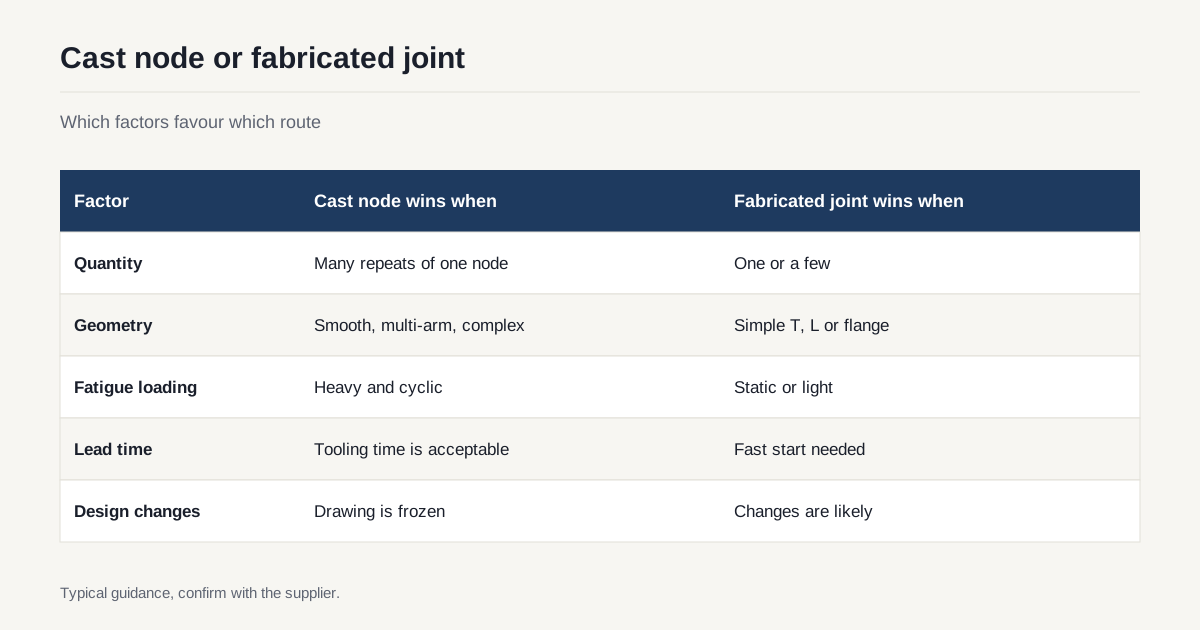
When the hybrid wins and when it does not
| Factor | Cast node wins | Fabricated joint wins |
|---|---|---|
| Quantity of the same node | Many repeats | One or a few |
| Geometry | Smooth, multi-arm, complex | Simple T, L or flange |
| Fatigue loading | Heavy, cyclic, high stress | Static or light |
| Lead time | Tooling time is acceptable | Fast start needed |
| Cost of tooling | Spread over many parts | Hard to recover |
| Design changes | Frozen drawing | Likely changes |
A hybrid is often the right answer when a structure repeats a complex junction and the fatigue life depends on it. It is the wrong answer for a one-off frame with a few simple joints, where a fabricated design is cheaper and faster. For a broader comparison of making methods see weldment vs casting vs billet.
What to ask the shops
A hybrid needs coordination between a foundry and a fabricator. In a lead-matching setup, the buyer often deals with the fabricator, who sources the casting. Ask these questions.
- Who supplies the casting, and is the tooling cost shown separately?
- What casting grade and standard apply, and what NDT level is included?
- How are repairs handled and documented?
- Which party owns the pattern or tooling after the order?
- What is the lead time for tooling, first article and series parts?
Closing checklist
Before you send the drawing, check these points.
- The node repeats enough to spread the tooling cost
- The casting grade is weldable and compatible with stress relief
- The drawing marks the weld ends with simple joints and the NDT extent
- Machined surfaces on the casting are identified for the foundry
- Tooling ownership and cost are stated in the quote
- The welding procedure covers the casting and the joining steel
Send your weldment RFQ with the node quantity and the joint details and each shop can say whether a casting makes sense.
Frequently asked questions
What is a cast node in a fabricated structure?
A cast node is a single casting that forms the junction where several tubes, plates or beams meet. The fabricated members are then welded to the casting's short stubs. The casting replaces what would otherwise be a complicated cut and welded joint with many weld seams in the same place.
How many parts make a cast node worth it?
The pattern or mould tooling is a fixed cost, so cast nodes pay when the same node repeats many times in one project or across orders. A single one-off junction is nearly always cheaper to fabricate. The crossover depends on node size, complexity and the casting supplier's tooling cost.
Can cast steel be welded to rolled steel plate?
Yes, if the casting is a weldable grade and the procedure is qualified for the combination. Weldable structural cast steels exist for this reason. The casting chemistry, its carbon equivalent and any repair welds on the casting must be known before welding.
Need a quote for this part?
Send the drawing. We match you with up to 3 shops that weld and machine it in house, and we reply within 24 business hours.
Get matched with a weldment shop