Gearbox Housing as a Weldment or a Casting: Quantity, Stiffness, Noise and Oil Tightness
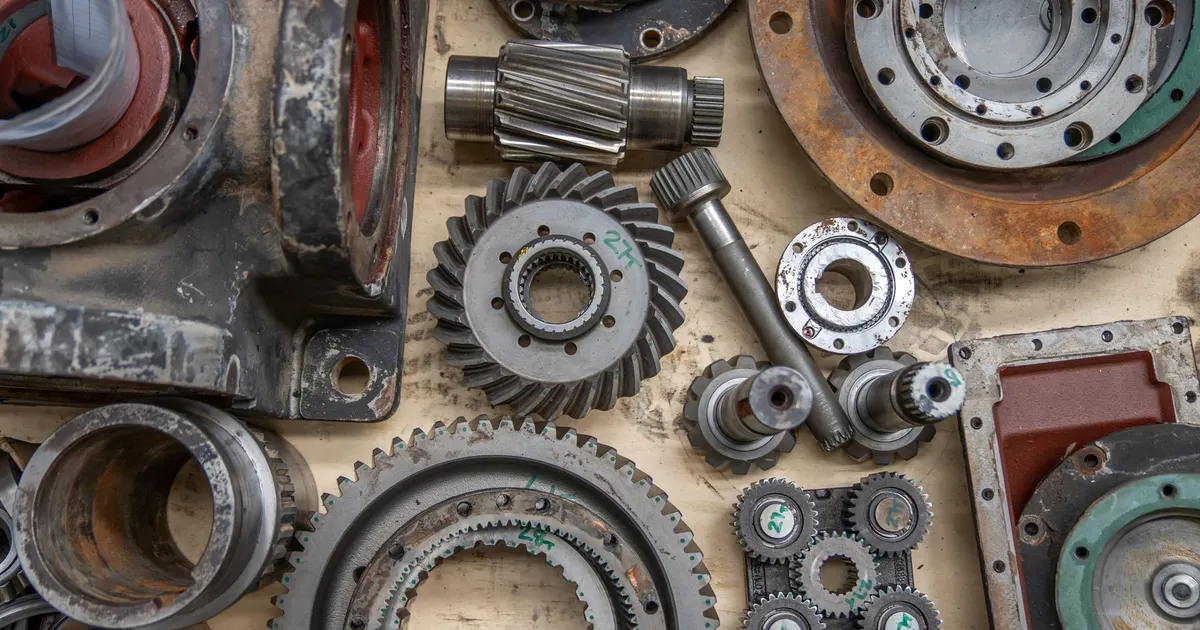
Gearboxes for industrial machinery come in two kinds of housing: cast and fabricated. Most catalogue gearboxes use castings because the maker builds thousands. A buyer who needs a special housing, a large one or a short series faces a real choice between a casting and a welded steel weldment.
This guide compares the two on the points that matter: cost by quantity, stiffness, noise, bore alignment and oil tightness, and explains the machining plan for a fabricated housing.
What a housing has to do
A gearbox housing has five jobs.
- Hold the bearings in line. Shafts run in bearings, and the centre distances and the alignment of the bores decide how the gears mesh.
- Resist the load. Gear forces try to pull the bores apart and twist the case.
- Contain the oil. The housing holds lubricant and keeps contamination out.
- Limit noise. The housing radiates the vibration of the gear mesh.
- Mount to the machine. Feet or flanges carry torque reaction to the frame.
The bore alignment is the demanding one. A tolerance of a few hundredths of a millimetre on centre distance is typical for precision gearing, and the bore axes must stay parallel under load.
Casting and fabrication compared
| Point | Casting | Fabricated housing |
|---|---|---|
| Tooling | Pattern or mould, a fixed cost | None |
| Lead time for first part | Longer, tooling comes first | Shorter |
| Cost at high quantity | Lower per part | Higher per part |
| Cost at low quantity | Higher per part | Lower per part |
| Design changes | Expensive, tooling changes | Easy, change the drawing |
| Size | Limited by foundry capacity | Limited by shop capacity and transport |
| Stiffness for the same section | Lower modulus of elasticity | Higher |
| Damping | Better with grey iron | Lower |
| Shape freedom | Very high | Limited by plate and weld access |
| Quality risks | Porosity, sand, shrinkage | Weld defects, distortion |
Neither is better in general. The right choice follows quantity, size, shape and noise needs.
Stiffness
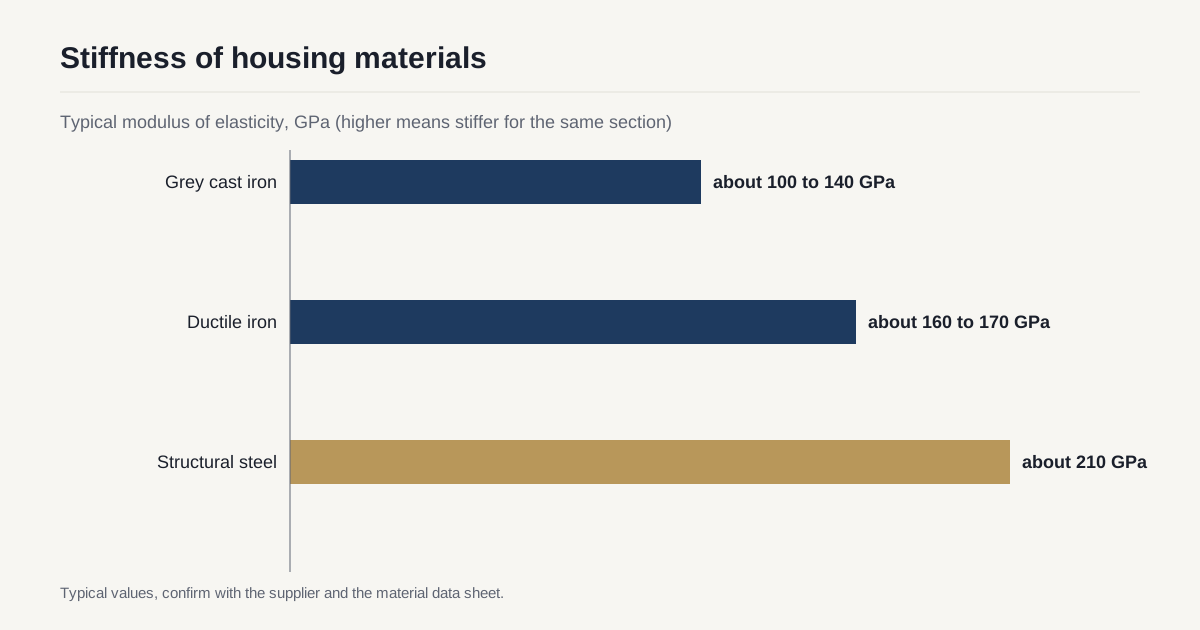
Steel has a modulus of elasticity of about 210 GPa. Grey cast iron is much lower, typically 100 to 140 GPa depending on the grade, and ductile iron is about 160 to 170 GPa. For the same wall thickness, a steel housing is considerably stiffer.
That means a fabricated housing can be lighter for the same stiffness, or stiffer for the same weight. In a heavy gearbox where bore deflection under load must be small, steel is attractive. The designer uses ribs and box sections to place material where it carries load.
Noise and damping
Cast iron damps vibration well because the graphite flakes absorb energy. Steel rings more. A fabricated housing that is not designed for noise can radiate more sound at the mesh frequency than a cast housing of similar size.
Designers manage this in several ways.
- Add ribs and cross walls to stiffen large flat areas, which raises their natural frequency
- Use thicker plate for the radiating panels
- Fit damping layers or constrained-layer panels
- Keep large unsupported flat plates small
If noise is a requirement, state it in the RFQ as a sound level at a given distance and load, or leave it as a design requirement for the housing designer. Fabricators who build housings regularly can say what they do.
Cost by quantity
The economics follow a simple pattern, and the numbers are shop specific. The casting has a fixed tooling cost and a low unit cost. The fabricated housing has no tooling and a higher unit cost, because it takes more labour for cutting, fitting, welding and machining.
The crossover quantity depends on size and complexity. A small housing may favour casting from a few dozen parts. A large housing with a weight of several tonnes may stay fabricated far longer because the pattern for a large casting is expensive and the foundry capacity is limited.
Ask each shop for prices at three quantities, such as 1, 10 and 50. That shows where the crossover lies for your part. The general comparison is in weldment vs casting vs billet.
Making a welded housing accurate
A fabricated housing is welded from plate, stress relieved and machined. The accuracy comes from the machining.
- Fit-up and welding. Plates are cut by laser or plasma, fitted in a jig and welded with balanced sequences. See weldment fixturing and fit-up.
- Stress relief. The housing is heat treated to remove welding stress. Without it the bores move when the housing is machined and again in service. Stress relief before machining explains the cycle.
- Machining. Bores, bearing seats, joint faces and mounting feet are machined from one setup where possible. A boring mill with a rotary table is common.
- Line boring. Bearing bores on a common axis are cut in line. See line boring bearing bores in a weldment.
- Inspection. Centre distances and bore alignment are checked with a coordinate measuring machine or laser, with a report.
A split housing, with a horizontal joint between two halves, is machined with the halves bolted together so the bores are cut as one. The halves are then separated, cleaned and reassembled with dowels.
Oil tightness and cleanliness
A gearbox housing is an oil container. Weld seams must be continuous and sound.
Design. Weld all seams that touch the oil space with continuous welds, not intermittent welds. Intermittent welds leave crevices that can leak or trap oil and dirt.
Testing. A leak test after machining proves oil tightness. A low pressure air test with a soap solution or a pressure decay test is common. See pressure and leak testing welded tanks and manifolds.
Cleanliness. Weld spatter, scale and blast media left inside a housing wreck gears and bearings. Specify internal blasting, flushing and a cleanliness check. Shot blasting weldments covers the blasting sequence and how trapped abrasive is avoided.
Internal coating. An oil resistant paint inside the housing seals the surface and prevents rust during storage. Mask the machined faces.
Typical material and plate
Fabricated housings are usually made from structural steel plate. Low carbon grades give good weldability and machinability. Thick sections for bearing bosses are plate or forged rings welded in.
| Part of housing | Typical practice |
|---|---|
| Walls and ribs | Structural steel plate, often 10 to 40 mm |
| Bearing bosses | Thick plate or rings, welded in and bored after stress relief |
| Joint faces | Machined flat with a stated flatness |
| Mounting feet | Thick plate, machined flat and coplanar |
The material choice follows the load and the temperature. Check weldment material selection and cost for the cost side.
What to put in the RFQ
- The housing drawing, the weight and the number of units, plus likely repeat orders
- The bore diameters, tolerances and the centre distances with their tolerances
- Alignment and parallelism requirements between bore axes
- The joint face flatness and any split line
- The oil capacity and any test pressure or leak test requirement
- The cleanliness level inside the housing and the internal coating
- The noise requirement if any
- The inspection method and report
Closing checklist
Before you send the drawing, check these points.
- The quantity forecast covers the first order and the likely repeats
- You have asked for prices at three quantities to see the crossover
- Bore tolerances and centre distances are tied to datums
- Stress relief is stated and comes before final machining
- Oil tightness and cleanliness are specified, not assumed
- Noise is a stated requirement if it matters
Send your weldment RFQ with the quantities and the bore tolerances and each shop can show where a fabricated housing makes sense.
Frequently asked questions
When is a fabricated gearbox housing cheaper than a casting?
At low volumes. A casting needs a pattern or mould, which costs a fixed amount, and that cost is spread across the batch. A fabricated housing needs no pattern, so it wins for one-offs, prototypes and small series. As the quantity grows, the casting's lower unit cost eventually overtakes it.
Is a welded housing noisier than a cast one?
It can be. Cast iron damps vibration better than steel. A welded steel housing can be made as quiet with design measures such as ribs, thicker walls and damping treatments, but it needs deliberate attention to noise at the design stage.
How is a welded housing made oil tight?
By designing the seams for continuous welds, testing the housing for leaks after welding and machining, and cleaning it internally. A pressure or bubble test finds leaks. Internal blasting and flushing remove scale and spatter that would otherwise reach the gears.
Need a quote for this part?
Send the drawing. We match you with up to 3 shops that weld and machine it in house, and we reply within 24 business hours.
Get matched with a weldment shop