What a Horizontal Boring Mill Does for a Welded Frame That a Machining Centre Cannot
A welded frame that weighs several tonnes and has bores on four sides is a poor fit for most machine shops. It will not fit under a vertical spindle, it cannot be turned by hand and every extra setup adds crane time and a chance of error. The horizontal boring mill exists for this kind of part.
This guide explains what the machine does, how the two main types differ and what a buyer should put in the RFQ so the shop can quote the right machine.
What a horizontal boring mill is
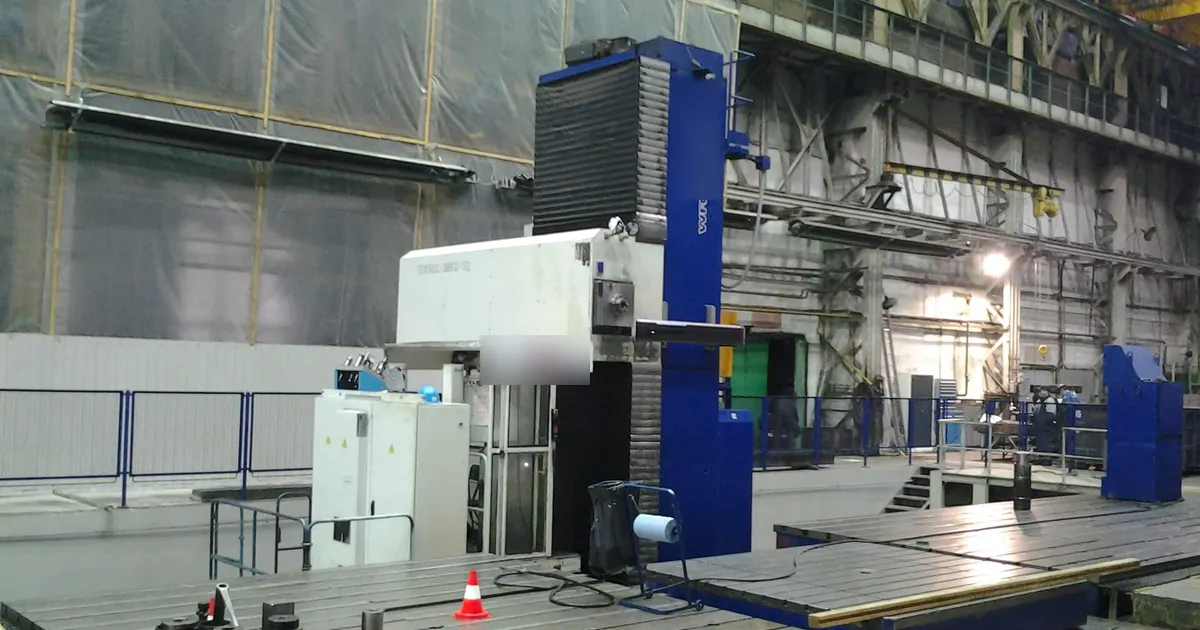
A horizontal boring mill has a spindle that points sideways and moves in and out along its axis. The spindle head rides up and down a vertical column and the column moves along the bed. The part sits on a table in front of the spindle, or on floor plates beside the column.
Most machines carry a large diameter spindle, often in the range of 100 to 200 mm, and a ram or quill that extends the cutting tool further into the work. That extension is what lets the tool reach deep into a box shaped weldment and bore a hole through two walls from one side.
Heavier tools such as facing heads can be fitted. A facing head has a radial slide that moves the tool across a face while it rotates, so one machine can face a large flange, bore a hole and cut a groove without changing the setup.
Table type and floor type
The two types suit different parts.
| Type | How the part is held | Typical part weight | Best for |
|---|---|---|---|
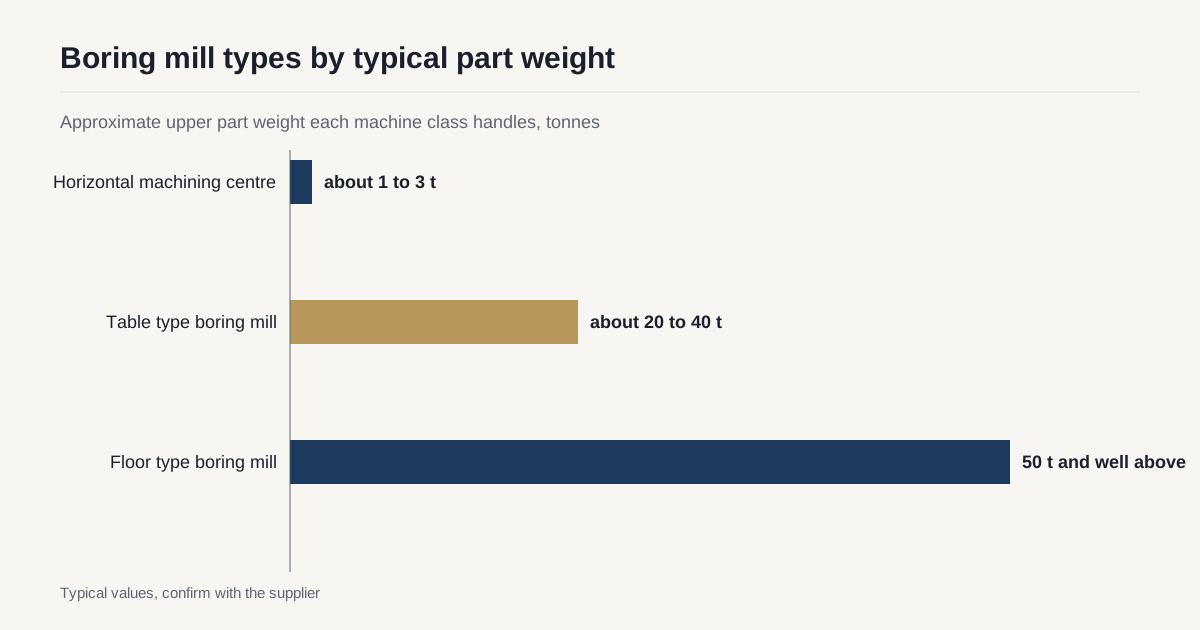
| Table type | On the machine’s rotary table | Up to about 20 to 40 tonnes | Frames and housings that need face indexing |
| Floor type | Clamped to floor plates beside the column | Heavy and long parts, often well beyond 50 tonnes | Very large frames, beds and bases |
| Horizontal machining centre | On a pallet with a rotary axis | Up to about 1 to 3 tonnes | Smaller weldments and housings in volume |
A table type machine has a built in rotary table that indexes in small angular steps, so the shop can turn the part to a new face while it stays clamped. This is the feature that makes the machine popular for weldments.
A floor type machine gives up the table and gains reach. The column travels along rails, sometimes several metres, and the part stays fixed on a bed of floor plates. Alignment takes longer because each part must be levelled on the plates, but there is almost no limit on part length.
Why weldments suit this machine
A machined weldment is usually a box, a frame or a ring with a bearing bore, a mounting face and several flanges. Those features sit on different faces and must relate to each other within a tight tolerance.
If each face needs its own setup, the tolerance between faces depends on how well the shop re-finds its datums each time. On a heavy part that means a crane lift, fresh clamping and indicating the part again. A tolerance stack builds up across those setups.
When the part sits on a rotary table the relationship between faces comes from the machine’s own table positioning, which is far more repeatable than a re-clamp. That is the practical reason to specify a boring mill for features that must align across faces. The same logic is behind the advice in machining setups on a large weldment: fewer setups cost less and hold alignment better.
What the process looks like
The usual sequence on a table type machine runs as follows.
- The shop checks the stress relieved weldment against the drawing and marks datum points.
- The part is lifted onto the table and levelled, usually with jacks or wedges and indicators.
- The first face is machined, often the one carrying the main datum surface.
- The table indexes to the next face and the features there are machined from the same clamping.
- Bores are roughed, semi finished and finished with a boring bar. Finish passes happen last so that the clamping stress has settled.
- The part is inspected before it leaves the machine where the shop’s measuring tools allow, so that a correction cut is still possible.
Stress relief belongs before step 1. A weldment that still holds locked in stress will move once material is removed, and no boring mill can hold a tolerance on a part that is changing shape. See stress relief before machining for the sequence and the usual heat treatment ranges.
Spindle reach and its limits
Long reach is useful and it has a cost. A tool that extends 600 mm out of the spindle deflects more under cutting load than one that extends 100 mm. The deflection shows up as taper in a bore, chatter on the surface or a bore that is slightly undersize at the far end.
Shops manage this by taking lighter finish passes, using a stiffer boring bar and supporting long bars at the far end where the part design allows it. A through bore across a wide frame can use a bar that is supported on the opposite wall.
As a buyer you do not need to know the details. You need to know that a deep bore with a tight tolerance takes more time than a shallow bore with the same tolerance, and that the shop’s quote will reflect the extension needed. Mark the bore depth on the drawing so the shop can see it.
What affects the machining cost
Several drawing features push the hours up on a boring mill.
| Feature | Why it adds time |
|---|---|
| Bore tolerance tighter than about IT7 | Extra finish passes and a temperature settling period |
| Bores more than four times the diameter in depth | Longer tool extension, lighter cuts |
| Features on five or more faces | More indexing, more tool changes, more inspection |
| Large flat faces with a flatness callout | Facing head passes and a long cut |
| Bores that must be coaxial across a wide frame | Single pass line boring or a supported bar |
The hourly rate of a large boring mill is higher than that of a small vertical machine, because the machine itself is expensive and the crane time is part of the job. Ask each shop how it prices setup and machining time separately so you can compare quotes on the same basis.
What to put in the RFQ
A good RFQ for a boring mill job carries these items.
- Overall length, width, height and weight of the finished weldment
- The faces that carry machined features, numbered on the drawing
- Tolerances on bores, flatness and positions, with the datum scheme
- The bore depths and the through or blind status of each bore
- The material and any heat treatment already planned
- Whether stress relief is required and at what point in the sequence
- The inspection method the buyer expects, such as a layout report
Buyers who leave out the weight and the face count get quotes that assume the worst or the best, and the numbers cannot be compared. The RFQ checklist lists the fields in full.
Checking a shop’s capacity
Ask the shop for three facts about the boring mill that would machine your part.
- The table size and maximum load, or for a floor type the plate area and column travel
- The spindle diameter and the maximum ram extension
- The crane capacity over the machine, including the hook height
A machine that can hold the part on paper may still fail on crane height. If the crane cannot lift the part high enough to clear the table, the part cannot be loaded. This is a common reason for a quote to fall through late.
It is also worth asking whether the shop welds and machines in the same building. Moving a stress relieved frame between sites adds transport, a second crane lift and a handoff. The vetting guide covers the questions that expose it.
Closing checklist
Before you send the drawing out, confirm these points.
- The weight and overall size are on the drawing and in the RFQ
- Machined faces are numbered and the datum scheme is clear
- Bore tolerances and depths are given for every bore
- The stress relief step is stated, with its position in the sequence
- The inspection method and the acceptance report format are named
- You have asked each shop for its machine table size, spindle diameter and crane capacity
Send your weldment drawing with those details and the shops you are matched with can quote the right machine for the job.
Frequently asked questions
What is the difference between a table type and a floor type boring mill?
A table type machine has a rotary table that carries the part and sits on the machine bed. A floor type machine has no table of its own: the column runs along rails and the part is clamped to steel floor plates beside it. Table types suit parts up to a few tens of tonnes. Floor types suit the heaviest and longest frames.
Why not machine a big weldment on a vertical machining centre?
Usually because the part does not fit, or because the features sit on several faces. A boring mill reaches the side faces by rotating the table, so the part stays clamped once. A vertical machine needs the part unclamped, turned and re-indicated for every face.
Does a boring mill give a better bore tolerance than other machines?
Not automatically. Bore tolerance depends on the machine condition, the cutter, the spindle extension and the stability of the part. A boring mill is chosen because it can reach the feature in one setup, which removes setup error, rather than because the machine is more precise on paper.
Need a quote for this part?
Send the drawing. We match you with up to 3 shops that weld and machine it in house, and we reply within 24 business hours.
Get matched with a weldment shop