Stainless Frames for Food and Packaging Machines: Hygienic Welds, Finishes and Machined Interfaces
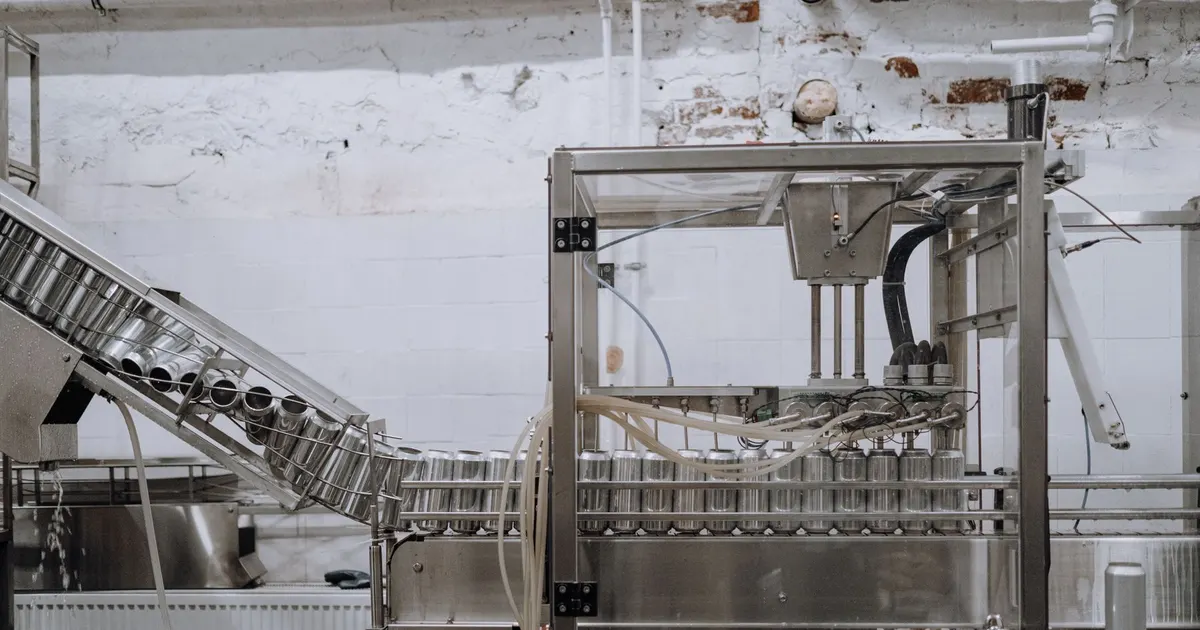
A packaging machine and a food processing machine have something in common with every other industrial weldment: a frame that carries a mechanism. They differ in one respect. The frame has to be cleaned, often daily with hot water, detergent and sometimes steam, and nothing on it may hold dirt. That changes the weld, the surface, the shape of every corner and the plan for machining.
This guide covers the hygienic features of a stainless steel machine frame and explains how they fit with the machined interfaces that the mechanism needs.
Material for food machine frames
Austenitic stainless steel is the standard.
| Grade | Typical use |
|---|---|
| 304 or 304L | General frames and covers, dry or mildly wet areas |
| 316 or 316L | Frames exposed to salt, acids or strong cleaning chemicals |
| Duplex | Heavy loading or chloride exposure, less common |
The low carbon L grades are preferred for welded parts, because they resist the carbide formation that causes corrosion beside welds. Stainless steel weldments explains the behaviour of these steels on welding, and duplex stainless welding covers the other family.
Plate and sheet are cut by laser or waterjet. Tube and square hollow section form legs, rails and cross members. Plate thickness is often 2 to 6 mm for covers and frames and 10 to 30 mm for base plates that carry heavy mechanisms.
What hygienic design means
Guidelines from bodies such as EHEDG and the 3-A Sanitary Standards describe hygienic design for equipment that handles food. They are standards to consult, and not a certification that a weldment shop holds. The ideas that matter to a fabricator are simple.
| Principle | What it means for the frame |
|---|---|
| No crevices | Continuous welds, no gaps, no overlapping plates that trap fluid |
| Smooth surfaces | Ground and polished welds, finished edges, no pits |
| Self draining | Slopes on horizontal faces, no ledges where water pools |
| Rounded internal corners | Radii large enough to clean, often 3 mm or more |
| Sealed hollow sections | Tube ends closed by welding, so nothing gets inside |
| Cleanable fasteners | Bolts with sealing washers, or no exposed threads in product zones |
These apply to the zone around the product more strictly, and they apply to every surface that is washed.
Continuous welds and sealed tube
A weld between a tube and a plate must run all the way round. A stitched weld leaves gaps, and the gap is a crevice. Every hollow section needs a sealed end, either a welded cap or a weld around the whole opening, so that cleaning water and product cannot enter and stay.
Closed boxes and sealed tubes create a problem during welding, because trapped air expands when it is heated and can blow a hole in the weld. Designers add a small vent hole at one end for welding and close it afterwards by welding or plugging.
Where a leak test is needed to prove a seal, see pressure and leak testing welded tanks and manifolds.
Weld finish
On exposed and product contact surfaces, the weld is ground flush with the plate and polished to a finish that matches the surrounding surface. The weld is not left as a raised bead with a rough ripple pattern.
Typical practice looks like this, although the customer’s specification decides.
| Surface | Typical finish | Notes |
|---|---|---|
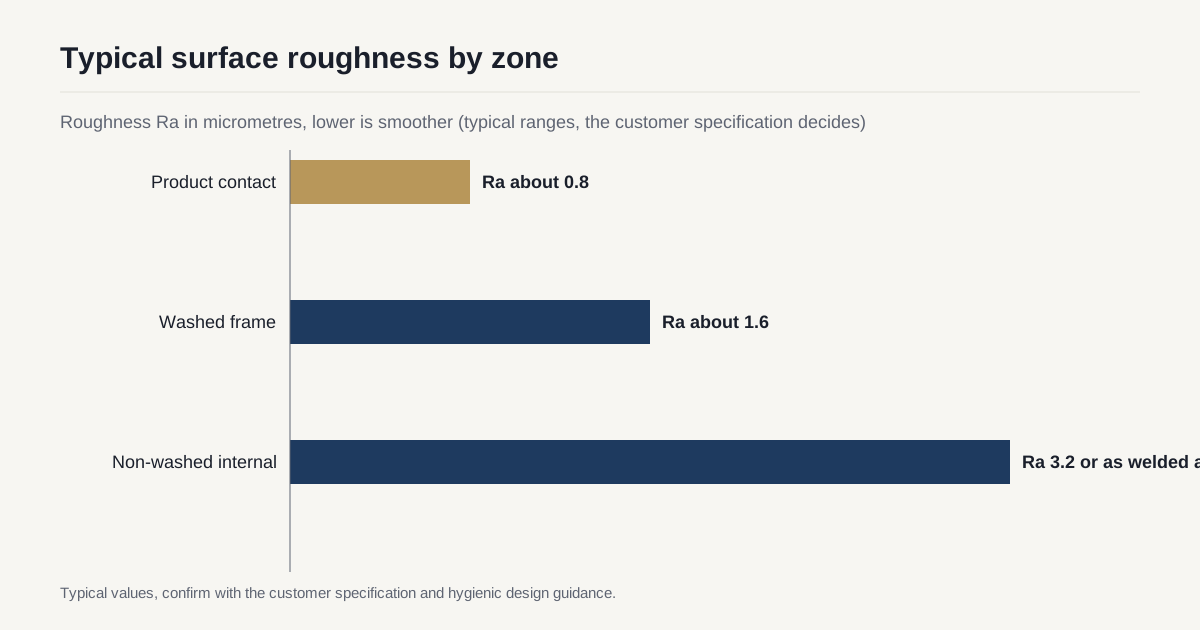
| Product contact | Roughness around Ra 0.8 micrometres, polished welds | Often electropolished for dairy and pharmaceutical |
| Frame, external, washed | Brushed finish, roughness around Ra 1.6 micrometres | Smooth enough to clean, cheaper to make |
| Non-washed internal frame parts | As welded and pickled, or brushed | Where hygiene does not apply |
State the finish by zone on the drawing, and avoid blanket requirements that apply the highest finish everywhere. A finish that is finer than needed adds polishing time and cost without improving the machine.
Pickling and passivation
Welding a stainless steel leaves a heat tint, a coloured oxide layer in which the chromium content is reduced. That layer has less corrosion resistance than the parent plate. It is removed by pickling with an acid paste or bath, or by mechanical methods such as brushing and grinding, and followed by passivation to rebuild the protective chromium oxide film.
A frame that skips this step can show rust staining next to the welds within weeks of washing. The specification should state the method and a check, such as a water break test or a test for free iron. If you blast stainless parts, use non-ferrous media, as explained in shot blasting weldments.
Distortion on thin stainless
A thin stainless sheet frame warps easily. Austenitic stainless expands more than carbon steel and conducts heat poorly, so the heat stays near the weld and moves the plate. The shop uses clamps, copper backing bars, short weld sequences and low heat input. See weld distortion control for the principles.
For a frame that carries a precise mechanism, the machining plan accepts a certain amount of movement and machines the mounting faces after welding.
Machined interfaces
Food and packaging machines contain mechanisms such as servo drives, cam units, conveyors and filling heads. These attach to the frame through machined faces and holes. Some points apply.
Flat mounting faces. A drive plate or a machine table is machined flat after welding, with a flatness of a few hundredths of a millimetre per hundred millimetres being typical for mechanisms. Machining allowance on weldments covers stock for the cut.
Threaded holes. Stainless threads gall. Designers use threaded inserts, sealed nuts or captive fasteners in food zones, and shops tap with the right tool and lubricant. Blind tapped holes in a washdown zone are a place where water collects, so through holes with sealed fasteners are often preferred.
Bearing seats and bores. A bearing bore in stainless is machined like any other, with sharp tools and a positive feed to avoid work hardening.
Datums. State datums on the drawing so the mechanism builder can rely on the machined faces. GD&T on weldments shows how.
Stress and stress relief
Stainless frames are not stress relieved in the way structural carbon steel is, for several reasons. Austenitic grades are susceptible to sensitisation if heated within a certain range, and thin frames can distort in the furnace. Shops rely on balanced welding, good fixtures and generous machining allowances instead. If a frame needs an accurate machined face, ask the shop how it deals with movement. The principles are in stress relief before machining.
Wash-down and ingress
Food machines are cleaned with water jets, so the frame must shed water. Electrical boxes, motors and sensors have their own ingress ratings, and they are the equipment designer’s concern. The weldment contributes by shedding water, providing drain holes and avoiding horizontal ledges. Ask whether the drawing marks slopes and drains, and whether the shop has built washdown frames before.
What to put in the RFQ
- The stainless grade and the product form, such as plate, sheet, tube
- A drawing that marks the hygienic zones and the finish for each
- The weld requirement: continuous, ground flush, polished in zones that need it
- Pickling and passivation with the acceptance test
- Sealed hollow sections and the venting rule during welding
- The machined faces, holes and threads with tolerances and datums
- The inspection and the documents: material certificates, weld maps, finish report
- Packing to protect surfaces during shipping, such as film on the finished faces
Closing checklist
Before you send the drawing, check these points.
- Hygienic zones and surface finishes are marked on the drawing
- All washed surfaces have continuous welds with no crevices
- Hollow sections are sealed, with vent holes during fabrication only
- Pickling and passivation are specified with a test
- Machined interfaces are separated from product zones and carry datums
- The shop has experience with stainless and a plan for distortion
Send your weldment RFQ with the grade, the finish by zone and the machined interfaces and each shop can quote the same frame.
Frequently asked questions
Why do food machine frames use continuous welds?
A gap between intermittent welds is a crevice where product, water and bacteria collect and cleaning cannot reach. Hygienic design calls for continuous, smooth welds on any surface that cleaning has to reach, so the frame can be washed down without leaving traps.
What surface finish is needed on a food machine frame?
It depends on the zone. Product contact surfaces usually need a smoother finish than external frame parts. Hygienic design guidelines often use roughness values around Ra 0.8 micrometres for product contact and a little rougher elsewhere. Check the customer's specification and the relevant guidance.
Can a frame be machined and still be hygienic?
Yes. Machined faces and holes are normal for mounting drives and mechanisms. The key is to avoid crevices around fasteners, to seal tube ends and to finish edges so they can be cleaned. The design should keep machined interfaces away from places where product collects.
Need a quote for this part?
Send the drawing. We match you with up to 3 shops that weld and machine it in house, and we reply within 24 business hours.
Get matched with a weldment shop