Lamellar Tearing: When a Weldment Needs Z35 Plate and When Joint Design Is Cheaper
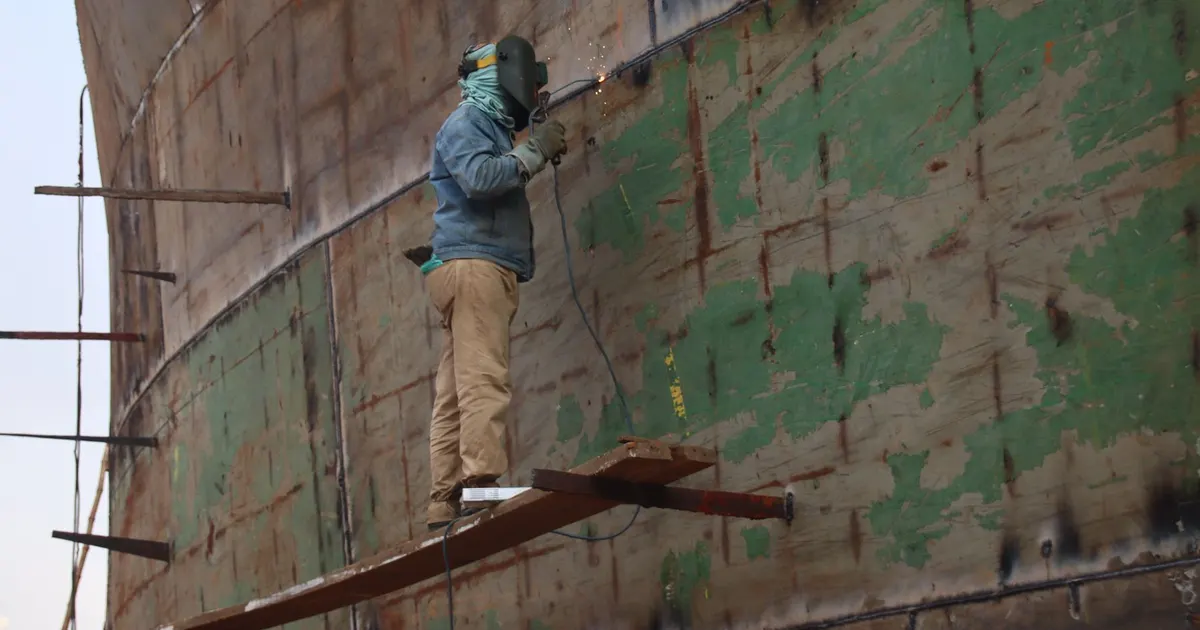
A weldment can pass every visual check and still hold a hidden crack inside a plate. The crack runs parallel to the plate surface, deep in the material, and appears only after the weld has cooled and the joint has been loaded by its own shrinkage. The defect is called lamellar tearing. It is the reason some drawings call for Z-grade plate, and the reason some of those calls are unnecessary.
This guide explains the cause, the grades and the practical choices between buying better plate and drawing a better joint.
What happens in the plate
Steel plate is rolled. During rolling, the non-metallic inclusions in the steel, mainly manganese sulphides and some oxides, are flattened into thin layers that lie along the rolling plane. The steel is strong and ductile when pulled along its length or width. When pulled through its thickness, perpendicular to the rolling plane, the flat inclusions act like a stack of weak layers.
Welding creates that pull. When a plate is welded at right angles onto the face of another, the weld shrinks as it cools. The shrinkage pulls on the receiving plate in the through-thickness direction. If the plate cannot stretch enough, small cracks open at the inclusions and join up in steps. The final crack has a terraced shape, which gives the defect its name.
Where it occurs
The risk concentrates in a small number of joint types.
| Joint | Risk | Reason |
|---|---|---|
| T joint with full penetration weld on thick plate | High | Weld shrinkage loads the receiving plate through its thickness |
| Corner joint with a thick plate welded at its end onto a face | High | Same direction of pull |
| Cruciform joint with welds on both sides | High | Through-thickness stress on the central plate |
| Butt joint | Low | Shrinkage acts along the plate, not through it |
| Fillet weld on thin plate | Low | Little restraint and little thickness |
Restraint makes it worse. A joint that is held rigid by the rest of the frame cannot relax as it cools, so the stress stays high. Thickness also raises the risk because thick plates carry more restraint and need more weld metal. Lamellar tearing is rare on plates under about 20 mm thick, and it is mainly a concern on heavy plates.
What the Z grades are
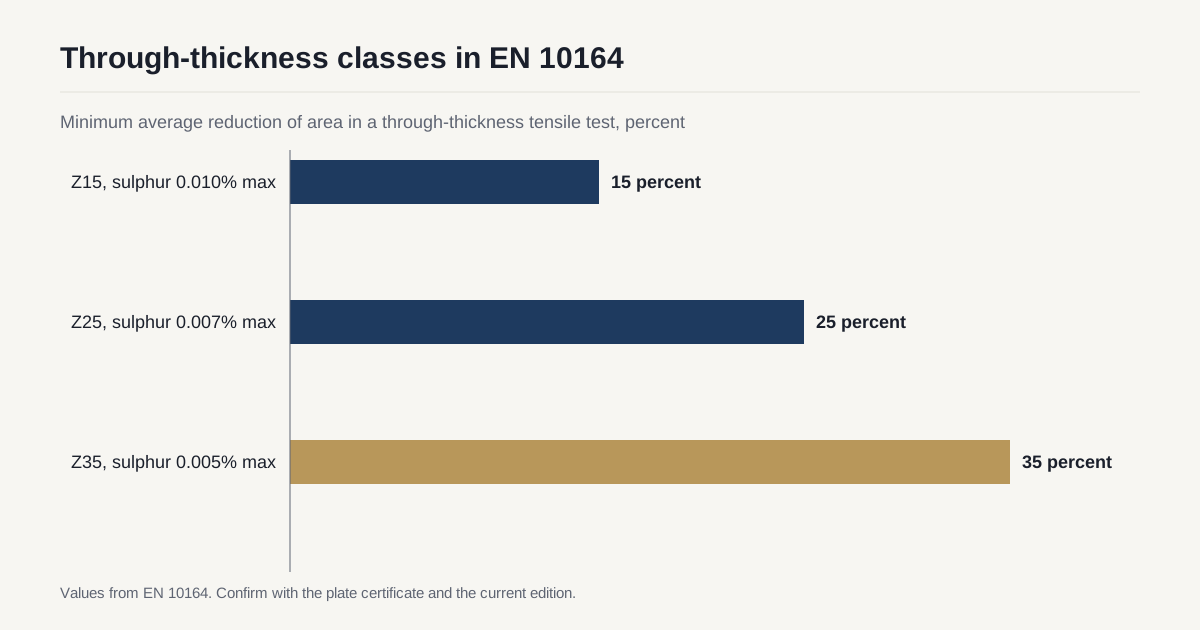
EN 10164 defines steel products with improved deformation properties perpendicular to the surface. The quality classes are named Z15, Z25 and Z35. Each guarantees a minimum reduction of area in a through-thickness tensile test.
| Class | Minimum average reduction of area | Minimum individual value | Maximum sulphur |
|---|---|---|---|
| Z15 | 15 percent | 10 percent | 0.010 percent |
| Z25 | 25 percent | 15 percent | 0.007 percent |
| Z35 | 35 percent | 25 percent | 0.005 percent |
The class is added to the plate grade, for example S355J2+Z35. ASTM has a related approach in ASTM A770, which describes through-thickness tension testing, and designers use it to ask for similar properties on plate to ASTM grades. The test takes small round specimens from the plate’s thickness direction and pulls them to failure.
Z35 plate is made with very low sulphur and often with inclusion shape control. That makes the inclusions less flat and the plate more ductile in thickness. It also makes the plate more expensive and sometimes slower to buy.
Design fixes that cost less than Z-grade
A designer who sees a high risk joint has several options before specifying Z-grade plate.
- Change the joint. Use a joint where the weld pulls along the plate, not through it. Rotate the arrangement so the receiving plate does not carry tension in the thickness direction.
- Reduce the weld size. A smaller weld shrinks less and loads the plate less. Partial penetration welds can often replace full penetration where the load allows.
- Balance the welds. Weld both sides of a T joint in turn so shrinkage forces are shared.
- Add a buttering layer. Weld a layer of soft, ductile weld metal on the surface of the receiving plate first, then weld the joint onto the layer. The soft layer absorbs the strain.
- Use a lower strength filler. A weld that yields slightly takes up some of the strain before the plate does. See choosing filler metal for a machined weldment.
- Control the sequence. Weld the high restraint joints early while the frame is still flexible. Weld distortion control covers the order of operations.
- Use preheat. Preheat lowers the cooling rate and the residual stress. It also reduces hydrogen cracking risk in the same zone, as set out in thick plate bevel prep and preheat.
These are design and procedure choices, and the design engineer owns them. Buyers do not need to select them, but a buyer who understands them can ask the right question when a quote includes Z-grade plate.
Checking the plate before welding
Z-grade is one control. Ultrasonic inspection of the plate is another. A scan of the plate before welding can find laminations, which are planar defects in the plate, and flag areas where inclusions are heavy. Standards such as EN 10160 and ASTM A435 and A578 describe plate ultrasonic testing.
Some designers combine controls: Z-grade for the receiving plate and an ultrasonic test of the plate before fabrication and after welding. The final inspection after welding is also an ultrasonic check of the plate beneath the weld, and it can find a tear that no visual inspection would show. Review the NDT guide for how to specify the extent.
What it means for machined weldments
Machined weldments often have exactly the joints that carry a risk: thick plates for bearing housings, flanges and base plates welded at right angles to other thick plates. Two points need attention.
First, a plate that will be machined can hide a lamination that the machining then exposes. A bore cut through a plate may open a lamination along its wall. This is a reason to plate-test material that will be machined heavily.
Second, machining removes material from the surface where the weld heat has acted. A buttering layer or a backing plate that is meant to be machined away must be thick enough to leave a sound surface after the cut.
See machining allowance on weldments for the allowance side, and weldment material selection and cost for the cost side.
What Z-grade costs
Z-grade adds cost in three ways.
- A premium on the plate price, because the steel needs lower sulphur and testing
- Fewer stocked sizes, which can add weeks to the lead time
- Testing and certification, with test specimens taken from the plate
The premium depends on the market and the quantity, so ask for it as a line item. If the quote adds a significant premium, check whether a joint change can remove the need. It is a fair question to put to the designer: does this joint really pull the plate through its thickness?
What to put on the drawing
Specify the control, and let the designer or the shop propose the route.
- Mark the joints that load the plate in the thickness direction
- Name the plate class for those plates, for example “S355J2+Z35 to EN 10164”, only where the design calls for it
- State any plate ultrasonic testing and the standard to be used
- State the weld sizes, the joint type and the inspection after welding for those joints
- Note any requirement for buttering, preheat or sequence
Closing checklist
Before you send the drawing, check these points.
- Joints that pull the plate through its thickness are identified
- Z-grade is specified only where the joint needs it, and the class is justified
- Joint design options have been considered first
- The plate certificate will show the through-thickness test result
- Ultrasonic inspection of the plate or the finished joint is specified where the risk is high
- The quote shows the Z-grade premium as a separate line
Send your weldment RFQ with the high risk joints marked and each shop can price the plate and the procedure that fit them.
Frequently asked questions
What is lamellar tearing?
Lamellar tearing is a stepped crack that forms inside the parent plate, under or beside a weld, along the rolling plane. It happens when shrinkage of the weld pulls on the plate in the through-thickness direction and the plate has poor ductility in that direction because of elongated inclusions.
What do Z15, Z25 and Z35 mean?
They are through-thickness quality classes in EN 10164. The number is the minimum average reduction of area in a through-thickness tensile test, in percent: 15, 25 or 35. A higher number means better ductility in the thickness direction and a lower allowed sulphur content.
Do all thick plate joints need Z-grade?
No. The risk depends on the joint type, the restraint and the plate thickness. Joints where one plate is welded at right angles onto the face of a thick plate and carries tension through the thickness are the ones to review. Design changes can remove the need in many cases.
Need a quote for this part?
Send the drawing. We match you with up to 3 shops that weld and machine it in house, and we reply within 24 business hours.
Get matched with a weldment shop