Press Frame Weldments: Stiffness, Flatness and the Machined Faces That Make a Press Accurate
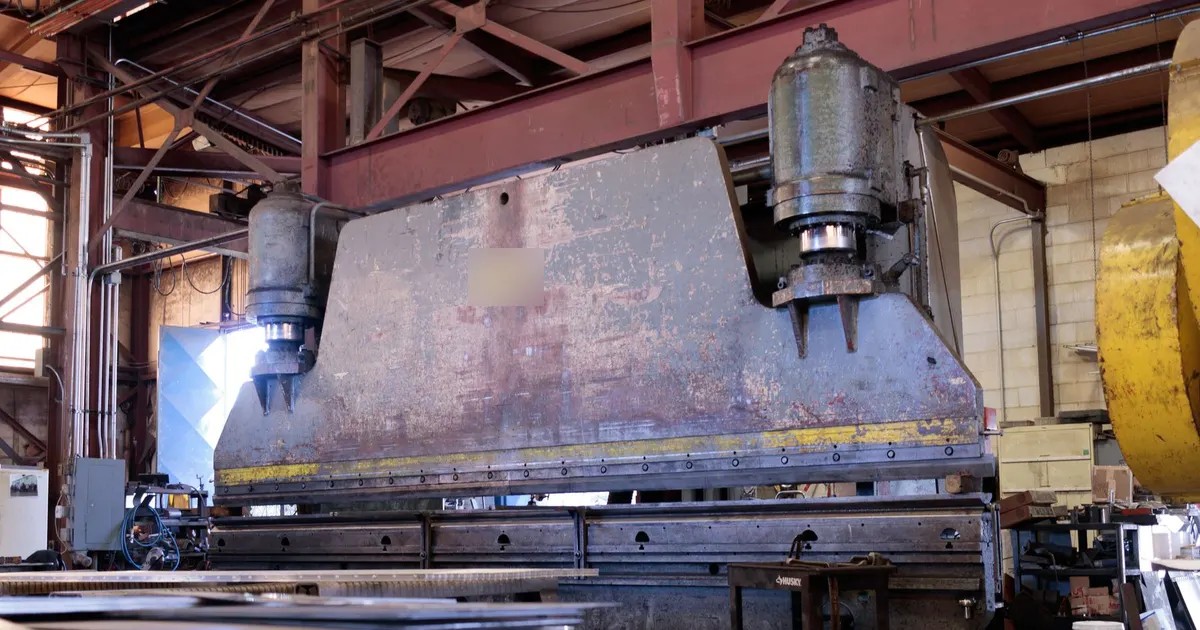
A press is only as accurate as the frame that holds it. The hydraulic cylinder, the moving slide and the bolster all depend on the frame to stay square under load, and the frame is a welded structure of thick plate with a handful of large machined faces. If those faces are out of parallel by a fraction of a millimetre, the tooling closes unevenly and the work suffers.
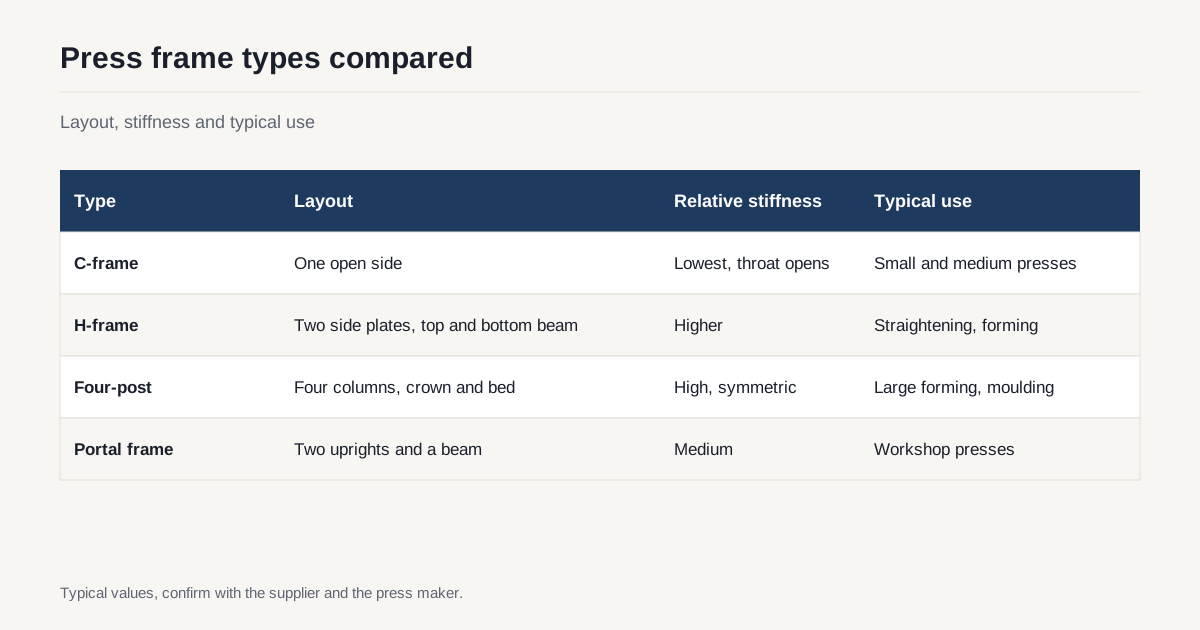
This guide explains the main frame types, what the designer controls and how the shop turns a stack of plate into an accurate frame.
Frame types
| Type | Layout | Typical use |
|---|---|---|
| C-frame (gap frame) | One open side, a C-shaped plate frame | Small and medium presses, easy access |
| H-frame | Two side plates joined by a top and bottom beam | Medium to large presses, straightening and forming |
| Four-post (column) | Four columns between a crown and a bed | Large forming and moulding presses |
| Portal frame | Two uprights and a beam, often bolted | Workshop presses with an open front |
The C-frame is the simplest to make and the least stiff at the throat, because the open side opens a little under load. The H-frame and four-post styles are stiffer and more symmetric, and cost more in plate and machining.
What a frame must do
The frame supports three things.
- The cylinder. It must hold the cylinder seat flat and square, so the force goes straight down the axis.
- The slide. The guides must be parallel to the cylinder axis, so the slide moves without side load.
- The bolster. The bed face must be flat and parallel to the slide, so the tooling meets squarely.
The frame also has to survive millions of load cycles. Every stroke stretches the frame slightly and releases it. That is a fatigue load, and the weld details have to be designed for it.
Deflection targets
A press frame does not behave as a rigid body. Under full load it stretches, and the throat of a C-frame opens. Designers set a limit on the movement of the bed and the slide relative to each other, often as a fraction of the bolster length or a number of hundredths of a millimetre per metre.
The numbers vary by press type and the maker’s standard. A forging press can accept more than a precision forming press. State the target on the drawing or ask the press maker for it, because the frame fabricator will not choose it alone. Where the deflection requirement is tight, the designer adds plate thickness and ribs, which adds weight and cost.
Welding thick plate
Press frames use thick plate, often 40 mm to 150 mm and sometimes more. The welds are full penetration, multipass and carry the whole load. Several points matter.
- Preheat and interpass limits. See thick plate bevel prep and preheat. Thick plate needs controlled heating to avoid hydrogen cracking.
- Joint design. Full penetration groove welds with a double V reduce distortion, as the weld volume is balanced about the mid plane.
- Lamellar tearing risk. A plate welded at right angles onto the face of another plate may need a through-thickness grade. See lamellar tearing and Z-grade plate.
- Inspection. Welds in the main load path are usually tested by ultrasound after welding. The NDT guide explains how to specify the extent.
Stress relief is not optional
A frame of 100 mm plate holds enormous locked-in stress after welding. If the frame is machined before relief, the stress releases as metal is removed, and the machined faces move. If the frame is relieved after finish machining, the heat treatment itself moves the faces.
The accepted order is weld, stress relieve, rough machine, then finish machine, sometimes with a second stabilising treatment for very precise presses. Stress relief before machining explains the cycle and the usual temperatures of 580 to 650 degrees C.
Ask where the frame will be relieved. A shop with its own furnace large enough for the frame avoids transport and a second handling. If the frame is too long for the furnace, a local heating method may be used, and the shop should explain the plan.
The machined faces
A press frame has a small number of large machined faces. Each has a flatness and a relationship to the others.
| Feature | Typical requirement |
|---|---|
| Cylinder seat | Flat and square to the cylinder axis |
| Bolster face | Flat over the full area, parallel to the slide |
| Slide guide faces | Straight and parallel to each other and to the axis |
| Crown and bed mounting faces | Parallel to each other, with a stated distance |
| Cylinder bore (where the cylinder is built into the frame) | Bored, honed or sleeved to the cylinder maker’s tolerance |
Typical flatness values on large faces range from 0.05 to 0.2 mm over a metre, depending on press class. Parallelism between faces on opposite sides of the frame is a longer measurement and can be set looser or tighter by the designer. GD&T on weldments shows how to call out flatness, parallelism and perpendicularity so the shop and the inspector read them the same way.
Machining plan
A large frame is machined on a floor type boring mill or a large planer mill. The shop plans the setups to keep the number low, because each setup is a crane lift. Horizontal boring mill work on large weldments and machining setups on a large weldment cover the machine and the setup cost.
A common plan machines the faces that define the frame’s datums first, then the faces that relate to them. The finish cuts are light, so cutting forces do not move the part.
Inspection and assembly
A press frame is inspected on the machine where possible. A laser tracker or a precision level and straightedge check flatness, parallelism and squareness. See laser tracker and CMM inspection of weldments for the tools and the report content.
For a built-in cylinder bore, the bore diameter, the roundness and the straightness are checked with bore gauges and a mandrel.
Some presses are trial assembled at the frame maker with a dummy slide or the actual cylinder, to confirm that the faces mate before shipping. Ask whether a trial assembly is included or priced as an option.
Cost drivers
| Driver | Why it matters |
|---|---|
| Plate weight | Plate cost scales with tonnage |
| Plate thickness | Thick plate needs more preheat and more passes |
| Deflection target | Tighter target means more plate and ribs |
| Heat treatment | Large furnace time or local heat treatment |
| Machining hours | Large faces and bores need long machine time |
| Inspection | UT of main welds and a layout of the faces |
A quote should show each of these. The machined weldment cost drivers guide gives a general framework.
What to put in the RFQ
- The press type, force and the stroke, with the frame drawing and the weights
- The deflection target or the press maker’s stiffness requirement
- The steel grade for each plate, the thicknesses and the impact requirement if any
- The weld joints and the NDT extent in the load path
- Stress relief and the point in the sequence
- The machined faces with flatness, parallelism, perpendicularity and datums
- Whether the cylinder bore is machined in the frame and the tolerance
- The inspection method and report
- Trial assembly, packing and transport requirements
The press frames application page gives more context on this type of part.
Closing checklist
Before you send the drawing, check these points.
- The frame type and the stiffness requirement are stated
- Heavy plate welds are marked as full penetration with an NDT extent
- Stress relief comes before finish machining
- The machined faces carry flatness and parallelism callouts tied to datums
- The inspection method is named and the report is defined
- The shop’s furnace and machine capacity are confirmed for the frame size
Send your weldment RFQ with the frame drawing and the face tolerances and each shop can quote the same press frame.
Frequently asked questions
Why are press frames welded instead of cast?
A welded frame can be made in any size without a pattern, and the design can be changed easily. Castings suit large runs of one size. A welded frame of thick plate is the usual choice for one-off presses and small series, and it can be made as stiff as a casting if the design and the machining are right.
What matters most in a press frame?
Stiffness and the accuracy of the machined faces. Under load the frame stretches and the faces move relative to each other. The design limits that movement, and the machining makes the faces flat, parallel and square so the tooling meets squarely.
Does a press frame need stress relief?
Almost always. A frame of thick plate holds large locked-in stress after welding. If it is machined without relief, it moves during machining and again in service, and the faces lose their accuracy.
Need a quote for this part?
Send the drawing. We match you with up to 3 shops that weld and machine it in house, and we reply within 24 business hours.
Get matched with a weldment shop