Charpy Impact Steel for Cold Service: How to Read the Grade and Test the Weld as Well
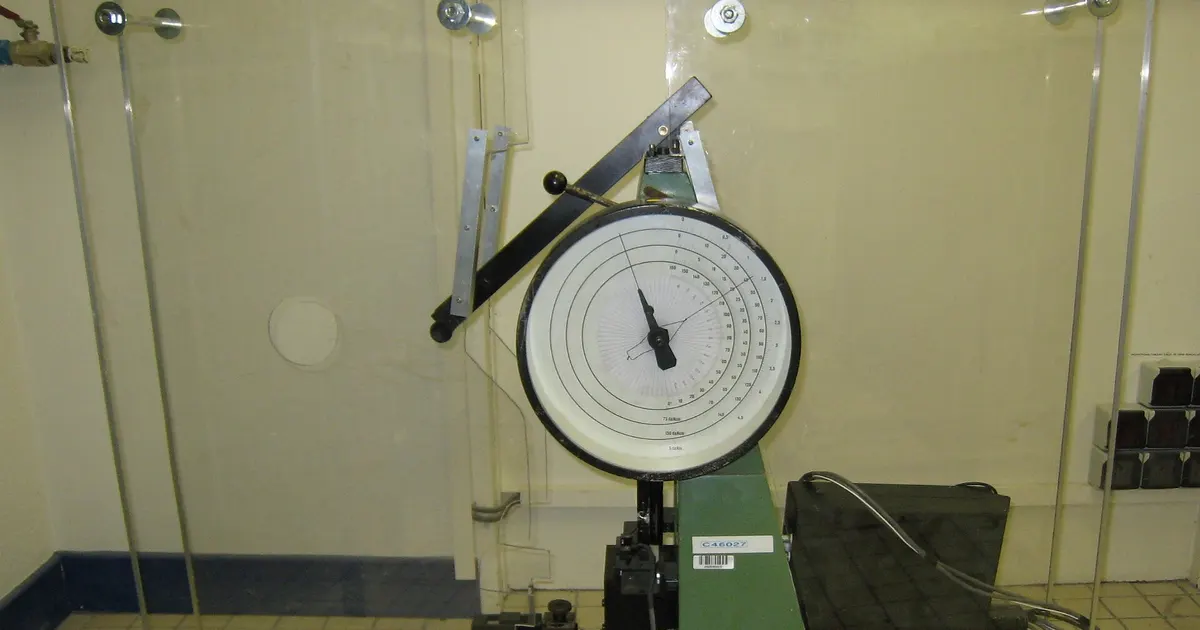
Steel that behaves like a tough, bendable metal at room temperature can snap like glass in the cold. The change is called the ductile to brittle transition. For a weldment that works outdoors in winter, in a freezer building or in a cold climate, the steel grade and the weld both have to stay tough at the lowest service temperature.
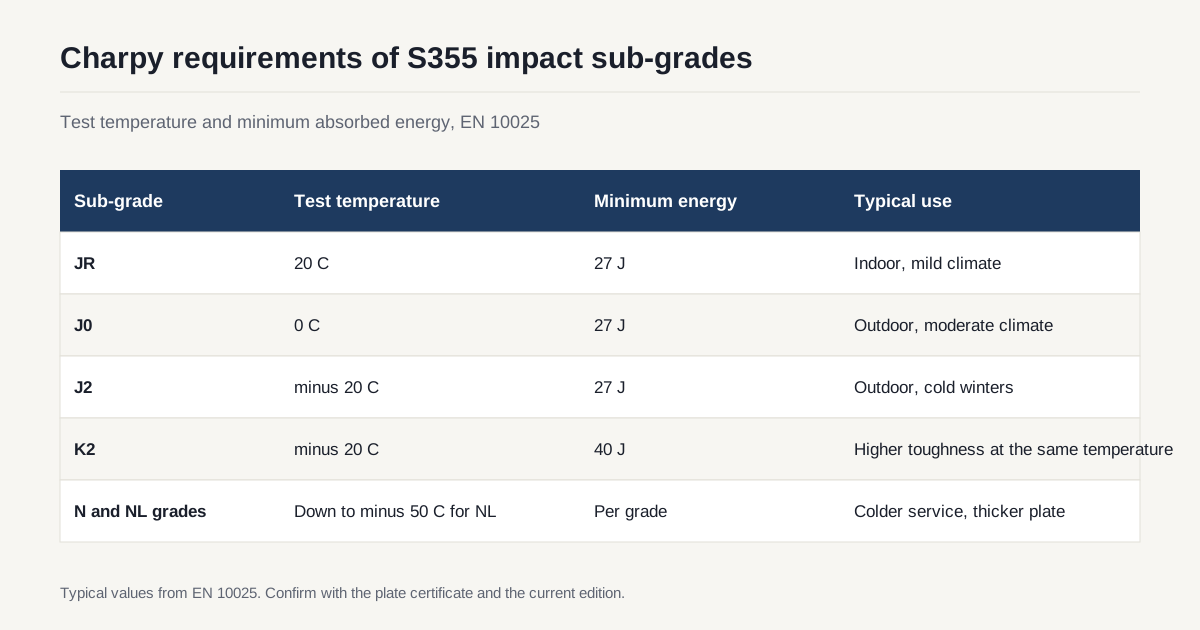
This guide explains the Charpy test, the grade names that carry a Charpy requirement and what a buyer must ask for to make sure the finished weldment, not only the plate, meets it.
What a Charpy test measures
A Charpy V-notch test uses a small bar of steel, usually 10 mm by 10 mm by 55 mm, with a V-shaped notch cut across it. The bar is cooled to a set temperature and placed on supports. A heavy pendulum swings down and strikes the bar on the side opposite the notch. The energy the bar absorbs while breaking is read from how far the pendulum swings afterwards. The result is in joules.
A tough steel bends and tears before it breaks and absorbs a lot of energy. A brittle one breaks with little deformation and absorbs very little. Tests at several temperatures draw a transition curve. At high temperatures the energy is high, and over a narrow range it falls sharply.
Typical requirements read like this: 27 J at minus 20 degrees C, or 40 J at minus 40 degrees C. The numbers are minimums for the average of three specimens, with a lower limit for any single one.
What the steel grade name tells you
Structural steel grades to EN 10025 carry the Charpy requirement in the name.
| Grade suffix | Test temperature | Minimum energy |
|---|---|---|
| JR | 20 degrees C | 27 J |
| J0 | 0 degrees C | 27 J |
| J2 | minus 20 degrees C | 27 J |
| K2 | minus 20 degrees C | 40 J |
For colder service, normalised and thermomechanically rolled grades give better toughness. In the EN system the letters N and M show the delivery condition, and an added L marks a grade with impact values guaranteed at low temperature, in some cases down to minus 50 degrees C. These fine grain steels cost more and are made in a narrower range of plate.
American practice uses different families. A516 Grade 70 normalised plate is a common pressure vessel steel with good toughness, and A333 pipe grades and A352 castings cover colder service, with Charpy testing at the specified temperature. Check the specification for the exact test temperature and energy.
For the comparison of two common structural grades see S355 vs A572 Grade 50.
Thickness matters
The same steel is more brittle when it is thicker. Three reasons stand out: thick plate restrains the material around a crack, forcing it into a state of triaxial stress; thick plate usually has a coarser grain structure; and thick sections hold more residual stress after welding.
Design codes handle this with tables that give the greatest permitted thickness for a grade at a design temperature. A plate that is acceptable at 20 mm in S355J2 at minus 20 degrees C may need K2 or an N grade at 60 mm. Designers use rules such as EN 1993-1-10 for structural work. For pressure equipment, ASME Section VIII has exemption curves that set a minimum design metal temperature by material, thickness and treatment.
For the buyer this means that the drawing should state both the minimum service temperature and the plate thicknesses, so that the grade can be checked.
The weld is the weak link
The plate certificate guarantees nothing about the weld. A weld has its own microstructure, and so does the heat affected zone, the strip of parent steel next to it. Both can be less tough than the plate.
The welding procedure qualification therefore includes Charpy tests on the weld metal and on the heat affected zone, at the design temperature, with the notch placed in the specified location. Those results are recorded on the qualification record. Without them there is no evidence that the weld is tough in the cold. WPS, PQR and welder qualification explains the records.
Several welding choices affect toughness.
- Filler. Nickel containing fillers deliver better low temperature toughness. See choosing filler metal for a machined weldment.
- Heat input. High heat input coarsens the grain and lowers toughness. Procedures set an upper limit.
- Interpass temperature. Too high a temperature between passes has the same effect.
- Preheat. It protects against cracking, and it should not be confused with toughness control. See thick plate bevel prep and preheat.
Post weld heat treatment and toughness
Stress relief can raise or lower weld toughness. For some steels it improves the heat affected zone by tempering hard structures. For others, holding at the stress relief temperature for a long time reduces toughness through grain boundary changes. The effect depends on steel and filler.
Qualify the procedure in the condition that production will use. If production includes stress relief, the Charpy tests on the qualification weld should be done after the same heat treatment. Stress relief before machining covers why a machined weldment is often relieved.
How testing is organised
Charpy testing comes in several stages.
| Stage | What is tested | Why |
|---|---|---|
| Plate certificate | Samples from the plate heat | Confirms the grade’s guaranteed values |
| Procedure qualification | Weld metal and heat affected zone from a test weld | Confirms the weld process gives tough welds |
| Production test plates | Optional test coupons welded with the part | Confirms production welds match the qualification |
Production tests are not routine for every part. They are applied when the code or the customer asks for them, usually on critical or high consequence structures. They add time and cost, so ask for them only when the part needs them.
A sample cut from the plate is tested at the temperature on the order and the machine is checked against reference specimens. The result comes with the test temperature, the specimen size and the energy for each of the three specimens.
Sub-size specimens and thin sections
Thin plate does not provide a full 10 mm specimen. Standards allow sub-size specimens, for example 7.5 mm or 5 mm wide, with the energy requirement scaled down. The reduced size must be stated, and the requirement adjusted accordingly. Below about 6 mm, Charpy testing is often not required at all.
If your weldment uses thin plate in cold service, ask the designer whether Charpy is needed and what the sub-size requirement would be.
Cost and lead time effects
Low temperature steel costs more and takes longer to buy.
- Normalised and fine grain grades carry a plate price premium
- Fewer thicknesses are stocked, which can lengthen the lead time
- The welding procedure may need to be re-qualified with Charpy tests, adding days and testing cost
- Heat treatment and test coupons add handling
Ask for these as line items. If a quote seems low, check that the plate grade and the procedure meet the cold requirement and that the shop did not quote room temperature steel.
What to put on the drawing
- The minimum service temperature
- The plate grade with the impact sub-grade and standard
- The plate thicknesses for each part
- The Charpy requirement for the weld metal and the heat affected zone: temperature, energy and notch location
- The condition: as welded or after heat treatment
- The certificate type for the plate, such as an EN 10204 type 3.1
Closing checklist
Before you send the drawing, check these points.
- The lowest service temperature is stated on the drawing
- The plate grade carries a Charpy requirement for that temperature and thickness
- The welding procedure qualification includes weld and heat affected zone Charpy tests
- The test condition matches production, including any stress relief
- The certificates will show the impact values
- The quote lists the cost of low temperature plate and testing
Send your weldment RFQ with the service temperature and thicknesses stated and each shop can quote the grade and the weld tests the part needs.
Frequently asked questions
What does a Charpy value of 27 J at minus 20 degrees C mean?
A standard V-notch specimen of the steel, cooled to minus 20 degrees C, absorbed at least 27 joules of energy when a pendulum broke it. The figure is a measure of toughness at that temperature. It is not a design load, but a way to compare steels and to check that the steel is not brittle at its lowest service temperature.
Is a tougher parent steel enough for a cold weldment?
No. The weld metal and the heat affected zone must also be tough at the design temperature. The welding procedure qualification should include Charpy tests from the weld and from the heat affected zone at that temperature.
Do thicker plates need a tougher grade?
Generally yes. For the same steel, thicker sections are more prone to brittle fracture because of higher restraint and a coarser structure. Design rules relate permissible thickness to grade and temperature, so a plate that is fine at 20 mm may need a better sub-grade at 60 mm.
Need a quote for this part?
Send the drawing. We match you with up to 3 shops that weld and machine it in house, and we reply within 24 business hours.
Get matched with a weldment shop