How to Pick Filler Metal: Strength Match, Toughness, Hydrogen and Machinability
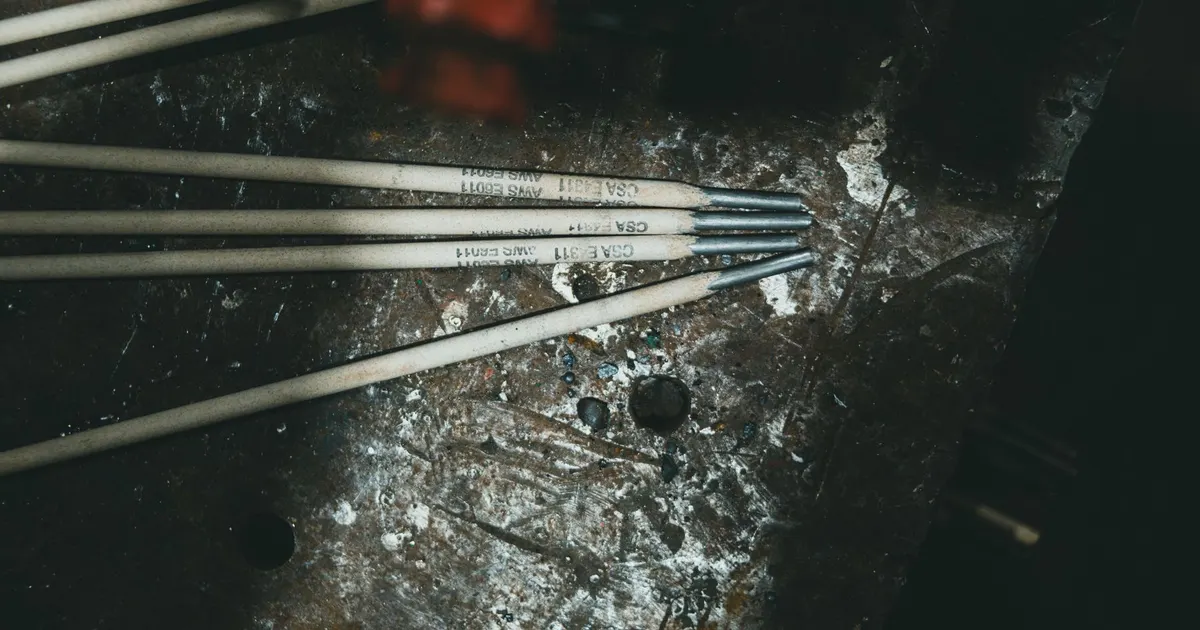
Filler metal is the part of a weldment that nobody sees after the weld cools, and it carries as much load as the steel on each side. A weld can only be as strong, as tough and as machinable as the filler allows. A drawing that leaves the choice open gets whatever each shop has on the shelf.
This guide explains the four questions that govern filler choice and what a buyer should state so that every shop quotes the same weld.
Question 1: how strong must the weld metal be
For a carbon or low alloy structural steel, the filler is usually chosen to match the parent steel’s strength. A filler for S355 or A572 Grade 50 is in the 70 ksi tensile class, which in the AWS system means a minimum tensile strength of around 490 MPa and in the European system a code such as G 42 for a common solid wire.
The strength levels are described in three ways.
| Term | Meaning | Typical use |
|---|---|---|
| Matching | Weld strength about equal to the parent steel | Most load carrying joints |
| Overmatching | Weld stronger than the parent steel | Joints where the weld is the weak point by geometry, such as small fillets |
| Undermatching | Weld weaker than the parent steel | Very hard or high strength plate, to reduce cracking |
Overmatching is not always better. A weld much stronger than the parent can be harder and less ductile, and it can concentrate strain in the heat affected zone. The design engineer decides how much to match. Buyers rarely do, and should not guess.
Question 2: what classification to write down
Fillers carry a classification that fixes their properties. The classification is printed on the electrode or the wire spool.
| Process | Example classification | What it tells you |
|---|---|---|
| Stick (SMAW) | AWS A5.1 E7018 | Tensile class, position, low hydrogen coating |
| Solid wire (GMAW) | AWS A5.18 ER70S-6 | Solid wire for gas shielded welding on carbon steel |
| Flux cored (FCAW) | AWS A5.20 E71T-1 | Flux cored, gas shielded, all positions |
| Submerged arc (SAW) | AWS A5.17 F7A2-EM12K | Flux and wire combination with tested impact value |
| TIG rod (GTAW) | AWS A5.18 ER70S-2 | Solid rod for gas tungsten arc welding |
European standards use a different code. For example, EN ISO 14341 describes solid wire for gas shielded welding with a code that shows yield level, impact temperature and shielding gas. The designation system differs, but the idea is the same.
The right classification depends on the parent steel, the process and the toughness the joint needs. A drawing or a procedure that names the classification takes the guesswork out. If you are unsure, state the performance you need, such as the minimum tensile strength and the impact energy at the service temperature, and let the shop propose the classification for approval.
Question 3: how much hydrogen can the joint tolerate
Hydrogen cracking is the main risk on thicker and stronger steels. The filler contributes hydrogen through moisture in the flux or coating and through contamination. Fillers are sold with a diffusible hydrogen designation, such as H4, H8 or H16, which states the maximum millilitres of hydrogen per 100 g of deposited weld metal.
A low number is better. A low hydrogen filler is a basic coated electrode such as E7018, or a clean solid or metal cored wire, handled and stored dry. Cellulosic stick electrodes and wet flux add hydrogen and are not suited to thick or high strength joints.
Practical consequences:
- Low hydrogen electrodes are stored in a heated oven and used within a set time after they come out
- Electrodes exposed beyond the time limit are rebaked according to the maker’s instructions or scrapped
- Flux for submerged arc welding is stored dry and rebaked if it picks up moisture
- Joints are clean and dry, and plate that has been in the cold is brought up to temperature before welding
Hydrogen control works together with preheat, which is explained in thick plate bevel prep and preheat. A shop with a clear drying and storage routine can describe it in a few sentences.
Question 4: how does the weld machine
This question matters for a machined weldment more than for a plain frame. The weld metal and the parent steel have to cut together.
Hardness. A weld metal harder than the parent steel resists the cutter, and the tool may skip or dig in at the transition. Matching strength fillers on structural steel generally machine well. Very high strength fillers and some low alloy types make a harder zone.
Work hardening. Austenitic stainless and nickel based fillers harden as they are cut. Machining them needs sharp tools and positive feed, as discussed in stainless steel weldments.
Uniformity. A weld with uneven hardness along its length gives a changing cut. A procedure with controlled heat input and consistent passes gives a more uniform bead.
Colour and appearance. If the weld will be visible after machining, the filler should match the parent steel so that the finish is uniform. This is mainly a cosmetic point.
What stress relief does to weld metal
If the weldment is stress relieved at 580 to 650 degrees C, the heat treatment changes the weld metal too. Some fillers gain or lose strength and toughness during the hold. A filler that passes impact tests as welded can fall below the requirement after a long stress relief.
Fillers are therefore tested in two conditions, as welded and after post weld heat treatment, and the maker states which are available. If your part will be stress relieved, tell the shop at quote stage and make sure the filler has been qualified in the heat treated condition. See stress relief before machining for the reasons and the usual cycle.
Filler for different steels
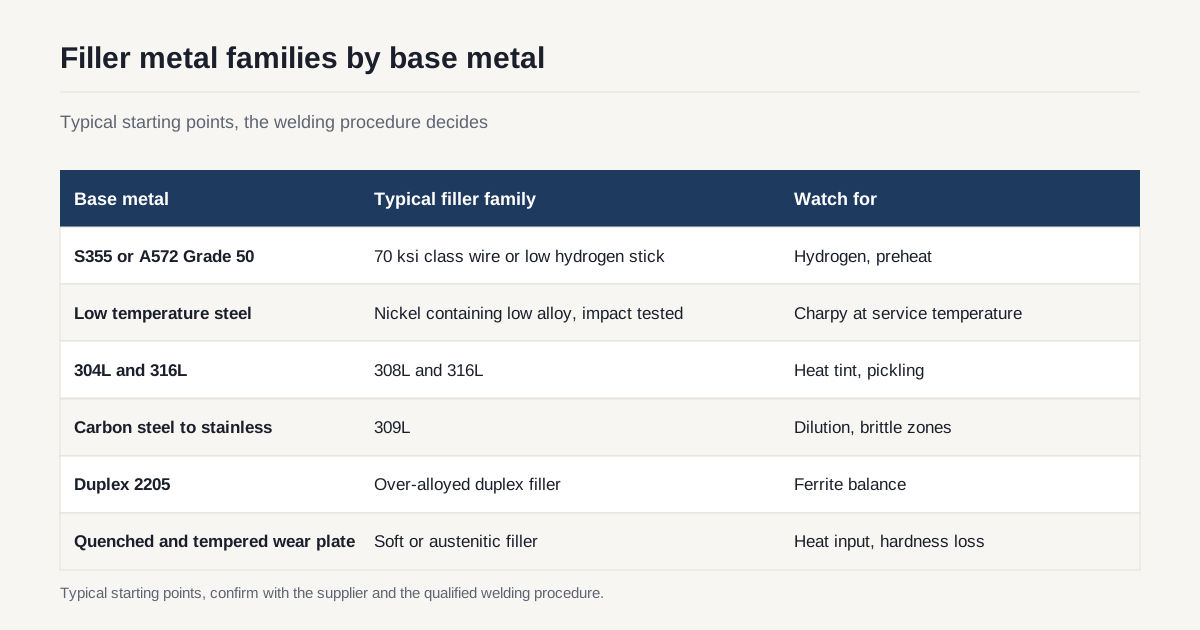
The table below shows typical filler families for common base metals. It is a map, not a recommendation, and the welding procedure decides.
| Base metal | Typical filler family | Note |
|---|---|---|
| Structural carbon steel such as S355 or A572 | Carbon steel solid wire or low hydrogen electrode, 70 ksi class | Most common case |
| Low temperature steels | Nickel containing low alloy filler with impact testing | Charpy requirement, see low temperature steels |
| 304L and 316L stainless | 308L and 316L filler | Matching low carbon grades |
| Carbon steel to stainless | 309L filler | Higher alloy to dilute the mixing |
| Duplex 2205 | Over-alloyed duplex filler | See duplex stainless welding |
| Quenched and tempered wear plate | Low strength or austenitic filler | See wear plate in weldments |
| Aluminium 5xxx and 6xxx | 5356 or 4043 type | Choice affects strength and colour after anodising |
Dissimilar metal joints need particular care. Mixing carbon steel with stainless needs a filler that can absorb the dilution without forming brittle structures, which is why the over-alloyed 309L is common.
Records the buyer can ask for
A shop that controls filler can show records.
- The filler classification and the manufacturer’s certificate for the batch
- The consumable storage and drying routine
- The welding procedure that names the filler, with qualification results
- For stainless and special alloys, material identification of the filler before use
If the part has a code requirement, the filler lot may be recorded against the weld. That is traceability, and it adds time. Ask for it only where the part needs it, and say so at the quote stage. See WPS, PQR and welder qualification for the procedure side.
What to write on the drawing
Keep it short and specific.
- The parent steel grade
- The welding process or processes allowed
- The minimum weld metal strength and the impact requirement at temperature
- The maximum diffusible hydrogen level where cracking is a risk
- The post weld heat treatment, if any
- The qualified procedure or the standard it must follow
Leave the exact wire or electrode brand to the shop. State the performance, and the shop picks a filler that meets it and shows the classification for approval.
Closing checklist
Before you send the drawing, check these points.
- The filler requirement is written as strength, impact and hydrogen, not as “suitable wire”
- The post weld heat treatment is named if it applies
- Dissimilar joints are marked and the filler for them is agreed
- The shop describes how it stores and dries low hydrogen consumables
- The filler is covered by the welding procedure qualification
- You have asked for the classification of the filler in the quote
Send your weldment RFQ with the filler performance stated and each shop can quote a weld that meets it.
Frequently asked questions
Should the filler metal match the strength of the parent steel?
Usually the weld metal should be at least as strong as the parent steel in a load carrying joint. That is called matching or overmatching. Undermatching is sometimes chosen on purpose, for example on very hard plate, so the weld yields before a hard zone cracks. The design engineer makes that call.
Why does filler classification matter on a drawing?
The classification, such as AWS A5.18 ER70S-6 or an EN ISO code, defines the strength, the chemistry and the impact values the weld metal will deliver. A drawing that says only 'weld with suitable wire' leaves each shop to pick its own, so quotes and results differ.
Does the filler affect machining?
Yes. Weld metal harder than the parent steel cuts differently, and a stainless or nickel based filler work hardens. If a weld crosses a machined surface, the weld metal and the parent steel have to cut cleanly together, so the filler hardness and the heat treatment matter.
Need a quote for this part?
Send the drawing. We match you with up to 3 shops that weld and machine it in house, and we reply within 24 business hours.
Get matched with a weldment shop