Welding Duplex Stainless Frames: Heat Input, Ferrite Balance and What It Means for Machining
Duplex stainless steel is chosen when a part needs strength and corrosion resistance together. Its yield strength is roughly double that of 316L, and it resists chloride attack and stress corrosion cracking better. Those gains come with a catch. The steel gets its properties from a balance of two phases, and welding can destroy the balance.
This guide explains the balance, the welding limits that protect it and what changes when a duplex weldment also needs machining.
What duplex means
Duplex stainless steel has a microstructure of two phases in roughly equal parts. Ferrite gives strength and resistance to stress corrosion cracking. Austenite gives toughness and general corrosion resistance. The common grades are 2205, also written as UNS S32205 or S31803, and the higher alloyed super duplex grades such as 2507.
The balance is set at the mill by composition and a controlled heat treatment. Nitrogen is added to help form austenite and to raise strength and pitting resistance.
When the steel is welded, it is heated into the single phase ferrite range and then cooled. If it cools too fast, the austenite does not have time to re-form and the weld ends up with too much ferrite. If it cools too slowly or sits at certain temperatures, harmful phases form. Both extremes reduce toughness and corrosion resistance.
The ferrite range
A welded duplex joint is judged by its ferrite content. A typical accepted range is roughly 30 to 70 percent ferrite in the weld metal, with narrower windows for severe service. The limit is set by the specification or the customer, and it should appear in the welding procedure.
| Condition | Effect |
|---|---|
| Too much ferrite | Lower toughness and reduced corrosion resistance in the weld and heat affected zone |
| Balanced ferrite | Strength, toughness and corrosion resistance as the grade intends |
| Too little ferrite | Lower strength, and in some cases lower resistance to stress corrosion cracking |
Ferrite is measured with a magnetic instrument that reads a ferrite number, or by point counting on a polished section under a microscope. The method and the acceptance range should be named in the procedure qualification.
Filler metal and shielding gas
A duplex weld uses filler with extra nickel so that the weld metal forms enough austenite on cooling. For 2205 the filler is commonly an over-alloyed type that carries about 2 to 3 percent more nickel than the parent plate. Matching composition filler would give a weld with too much ferrite.
The shielding gas also matters. Argon based mixtures with a small addition of nitrogen, often in the range of 1 to 3 percent, help hold nitrogen in the weld. Back purging with argon or an argon nitrogen mix protects the root. Choosing filler and gas is covered in choosing filler metal for a machined weldment.
Heat input and interpass temperature
Duplex needs a heat input in a window. Too low, and the weld cools quickly, which produces too much ferrite. Too high, and the heat affected zone spends too long in the temperature range where brittle phases form.
| Control | Typical practice for 2205 |
|---|---|
| Heat input | Often about 0.5 to 2.5 kJ per mm, set by the procedure |
| Preheat | Usually none, unless the plate is cold or wet |
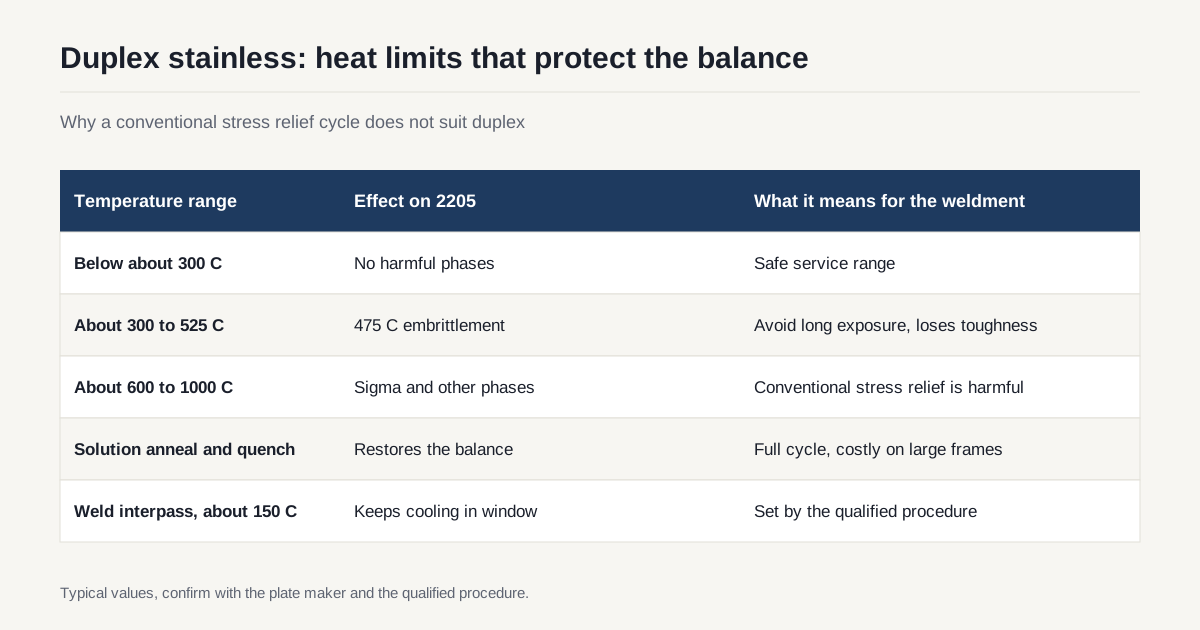
| Maximum interpass | Often around 150 degrees C, set by the procedure |
| Cooling | Natural air cooling, no forced quench between passes |
These figures are typical orders of magnitude for the 2205 grade. Super duplex has tighter limits, and the plate maker’s recommendations and the procedure qualification set the real ones. A shop that welds duplex regularly can state them without hesitation.
Why stress relief does not work
For carbon steel, stress relief before machining is the normal way to stabilise a weldment. For duplex stainless, the usual cycle is harmful.
Between roughly 300 and 525 degrees C, duplex can embrittle through a process often called 475 degree embrittlement, because it is at its worst near that temperature. Between roughly 600 and 1000 degrees C, intermetallic phases such as sigma form and strip the steel of toughness and corrosion resistance.
A common structural stress relief of 580 to 650 degrees C therefore sits in the range that damages the steel. The only heat treatment that restores a duplex part is a full solution anneal at a much higher temperature, followed by rapid cooling. That is expensive, and a rapid quench on a large welded frame brings its own distortion.
For a machined duplex weldment this has practical consequences.
- Weld with balanced sequences and low heat input to limit stress at source
- Leave a generous machining allowance, and check machining allowance on weldments
- Machine in stages with a rest between rough and finish cuts
- Accept that the part may move and plan the tolerance for it
Distortion behaviour
Duplex stainless expands less than austenitic stainless. Its coefficient of thermal expansion is closer to carbon steel, roughly 13 micrometres per metre per kelvin against about 16 to 17 for austenitic grades. Its thermal conductivity is also higher than austenitic. The result is that duplex distorts less than 316L for the same weld, which is a real advantage. Compare this with stainless steel weldments, which covers the austenitic case.
The high yield strength has a different effect. Once a duplex part has moved, it resists being straightened, and the force needed is higher than for carbon steel.
Machining duplex
Duplex machines differently from carbon steel and from 316L.
- The yield strength of 2205 is at least 450 MPa, so cutting forces are high
- The steel work hardens, so a dull tool or a light, rubbing pass makes the next cut harder
- Chips are tough and stringy, so chip control matters
- Tool wear is faster, and carbide grades for stainless are the usual choice
Shops handle this with rigid setups, sharp positive tooling, constant feed and plenty of coolant. The effect on the quote is longer machining time and more tool cost than for 316L.
Corrosion checks after welding
A welded duplex part that will see chloride service is often tested to confirm its corrosion resistance. A common test is a ferric chloride immersion test under ASTM G48, which looks for pitting at a set temperature. The procedure qualification may call for it, and a part for severe service may need it on production samples.
After welding, the surface needs cleaning. Heat tint and weld scale are removed by pickling and passivation, or by mechanical cleaning followed by passivation. Without this the weld area has reduced corrosion resistance, as for any stainless steel. Remember that blasting a duplex part needs non-ferrous media, as explained in shot blasting weldments.
What to put on the drawing and in the RFQ
- The duplex grade and the standard, for example 2205 to the relevant ASTM or EN specification
- The ferrite acceptance range, or a note that the procedure sets it
- A requirement for a qualified welding procedure with the ferrite and corrosion test results
- The surface cleaning requirement: pickling, passivation and the acceptance test
- A note that stress relief by conventional heat treatment is not permitted
- The machining tolerances and the allowance expected
- Mill certificates that show chemistry, mechanical results and, where relevant, a corrosion test
Closing checklist
Before you send the drawing, check these points.
- The grade is named, and the shop has welded it before
- The procedure states heat input, interpass and ferrite limits
- Filler and shielding gas are chosen for duplex and not left as “matching”
- No conventional stress relief is called up anywhere on the sheet
- The machining allowance is on the generous side
- Pickling and passivation are specified, with a way to check them
Send your weldment RFQ with the duplex grade, the ferrite range and the machining requirements and each shop can show how it controls the weld.
Frequently asked questions
What is ferrite control in duplex welding?
Duplex stainless steel is a mix of ferrite and austenite phases, roughly half and half. Welding upsets the balance, usually towards too much ferrite. Ferrite control means choosing filler, heat input and cooling rate so the weld and the heat affected zone stay within an accepted ferrite range.
Can duplex stainless be stress relieved?
Not with the usual structural steel cycle. Heating duplex into certain temperature ranges forms brittle phases that damage toughness and corrosion resistance. Shops avoid stress relief heat treatment or use a full solution anneal and quench, which is expensive and hard on a large frame.
Is duplex harder to machine than 316L?
Generally yes. Duplex has a higher yield strength and work hardens, so cutting forces and tool wear are higher. Rigid setups, sharp carbide tools and constant feed help. The machining plan and the hours on the quote should reflect it.
Need a quote for this part?
Send the drawing. We match you with up to 3 shops that weld and machine it in house, and we reply within 24 business hours.
Get matched with a weldment shop